
When the Stars Meet the Soil


The laboratory hummed; the steady, rhythmic heartbeat of a small, modular plasma reactor sitting on a scarred wooden workbench in the open shed beside the laboratory. It is called the coil whine, the low hum made by current switching through transformers and coils, causing them to vibrate slightly.
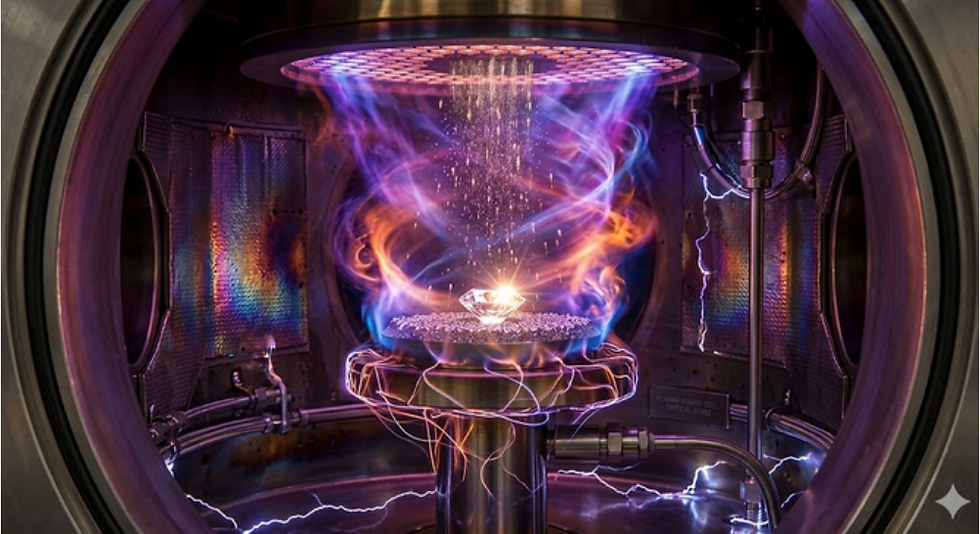
The plasma reactor was a simple one with an impressive name: Dielectric Barrier Discharge or DBD for short. Air pushed through the space between the dielectric shielded electrodes gets ionized and flows out with its characteristic glow. In a dark room, you will see a purple-blue glow made of thousands of tiny, flickering micro-discharges buzzing through the flowing gas.
A gas at ambient pressure situated in a strong electric field gets ionized by the process of electron impact ionization producing a fluid made up of electrons, ions and neutral molecules which we call plasma. The energy gained by the electrons gets transferred to the neutral atoms through collisions, which get heated, ultimately forming very hot plasmas with electrons and ions in thermal equilibrium.
However, if the electric field is applied in pulses with a pulse duration insufficient to produce thermal equilibrium, we get the non-equilibrium or cold plasma. Nanosecond-duration kilovolt pulse trains produce such cold plasmas. The electrodes are separated from the gas by a dielectric coating to ensure that no steady voltage appears between the electrodes.
For Jayan, the transition from the high-energy, high-stakes world of plasma physics to this humble, repurposed space in Kottayam had been a journey of scale. He had spent decades at the Institute for Plasma Research in Ahmedabad, lured initially by the promise of fusion. Disillusioned with the Sisyphean pace of progress in world fusion efforts, he had opted to pursue the high tech integration of plasma physics with material processing to yield useful short term applications. Now, he was applying that same fundamental science to something far more quiet, yet arguably more revolutionary: the transformation of ordinary water into a potent, life-giving elixir.
Before him sat a beaker of clear, municipal water. Perched over its surface, the reactor’s coaxial tube stood like a sentinel. As he flipped the switch, the air grew thick with the sharp, metallic tang of ozone. Inside the reactor, a pale, violet glow flickered into existence — an ambient pressure cold plasma discharge dancing across the surface of the liquid. It was a beautiful, chaotic interface where ionized gas met liquid, and the world of quantum states began to bend the chemistry of the mundane.
He was making Minnal Jalam — the Malayalam word for “lightning water.”
As a plasma physicist, he knew the theory intimately. The cold plasma was stripping electrons from nitrogen and oxygen molecules in the ambient air, forcing them to collide and reform into reactive species: nitrites, nitrates, and hydrogen peroxide. It was the same process that happens when a lightning strikes, but tamed, domesticated, and concentrated into a small, bubbling vessel. He watched as the pH of the water began to shift, the conductivity climbing, signalling the birth of a solution that was no longer just water, but a mild, nutrient-dense plasma-activated solution.
He thought of the fields of Central Travancore. He had seen the soil-tired, overworked fields, increasingly reliant on synthetic fertilizers that did more harm than good, leaching chemicals into the groundwater and hardening the earth. He remembered the conversations at the Senior Citizens’ Forum, where talk often drifted to the anxieties of the next generation of farmers. They spoke of costs, of soil degradation, of the unpredictability of the seasons.
He was not a farmer, but he was a man who understood the fundamental building blocks of the world. If he could turn the air itself into a nitrogen-rich catalyst, he could decentralize the very foundation of agriculture. It didn’t need to be a massive industrial plant; it could be a machine on every cooperative farm, running on a small solar array, breathing in the air and breathing out life.
The plasma flickered, and he adjusted the electrode setting. The water began to cloud slightly-a sign of the chemical restructuring taking place. He felt a familiar, quiet thrill. It wasn’t the thrill of a breakthrough discovery ready for publication in Physical Review Letters; it was the quiet, profound satisfaction of doing something useful. He was a scientist-artist, and this was his current masterpiece: an exercise in radical simplicity.
He remembered his time in Aligarh, the heady days when he learned plasma physics for the first time and of struggles to build his first plasma device. Reading old issues of Reviews of Scientific Instruments and Physical Review Letters revealed to him the potential of plasma to change the world. He had spent a good part of his life and career building and operating fusion devices and plasma material interaction systems, but now, he realized the most important work happened at the scale of a seedling’s roots.
The reactor clicked off, the violet glow vanishing instantly. The water sat still, though it was now fundamentally changed. It held a memory of the discharge — a kinetic change that would trigger germination, sanitize the seedbed, and provide a direct, bio-available source of nitrogen. He carefully poured the liquid into a watering can.
He walked out of the shed into the humid warmth of a Kottayam evening. The garden in the Mahatma Gandhi University was lush, filled with the deep greens of the tropics. He walked to the vegetable patch where he and the gardener had been experimenting with a few rows of okra. The soil here was richer, darker, and more resilient than the rest of the plot. He diluted the plasma-activated water with the patience of an old man who understood that growth cannot be rushed.
As he watered the plants, he imagined the microscopic dance occurring beneath the surface. The nitrates would be absorbed immediately; the reactive oxygen species would suppress the harmful fungi that had plagued these rows for years. It was a closed loop, a perfect integration of fundamental physics and human need.
He straightened his back, looking toward the horizon where the sun was beginning to dip, casting long, golden shadows over the trees. He had spent a good part of his life chasing the chimera of fusion, the grandiose promise to solve the world’s energy problems. As the reality of working reactors receded into more and more distant futures, he had switched his interest to more realisable short term applications. But as he watched the evening light catch the wet leaves, he realised he had finally found a different kind of fire. It was a cold, precise, and gentle fire, one that didn’t consume, but rather, nurtured.
He turned back toward his car, for the ride back home, after depositing the watering can in the laboratory. Tomorrow, there would be more measurements, more adjustments for the reactor’s optimisation, and perhaps later in the week a meeting at the Forum to explain the concept to the others. But for now, he was content. He was a retired physicist who had learned to catch lightning in a bottle, and for the first time in his life, he didn’t need a massive laboratory to make the world bloom. He only needed a little bit of curiosity, the air above his garden, and the simple, profound gift of water.

Comments