
The Methane Forge

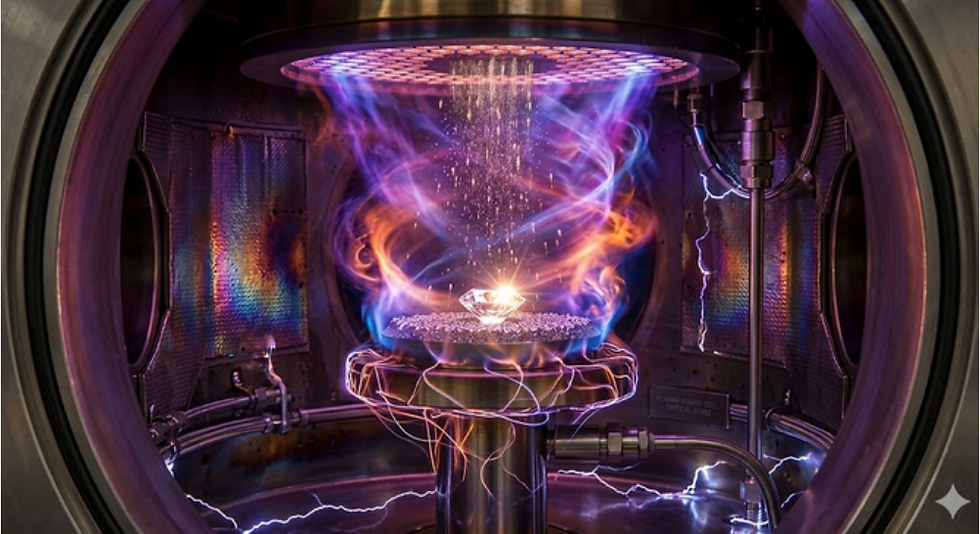
(Image created by Google Gemini)
The humid air of Surat clung to the skin like a damp shroud, but inside Harish bhai’s laboratory, the atmosphere was bone-dry and hummed with the electric tension of a brewing storm. Harish bhai, the man the local diamond bourses called the “Alchemist of Surat,” did not turn lead into gold. He changed the colour of diamonds and used plasma chemistry to convert methane into diamonds.
Standing beside him was his protégé, Ankit, a brilliant boy with an engineering degree from Stanford. His eyes reflected the violet glow of the reactor. They were staring into the viewing port of their newest Microwave Plasma Chemical Vapour Deposition (MPCVD) chamber. Inside, a small, square seed of diamond sat upon a silicon substrate, bathed in a sun-bright ball of plasma.
“It’s beautiful, isn’t it?” Ankit whispered. “To think, nature took millions of years 120 kilometers below the crust to do what we are doing in a week.”
Harish bhai adjusted a dial, his movements precise. “Nature uses the sledgehammer of the gods, Ankit. Forty-five thousand atmospheres of pressure and temperatures up to 1300°C. It waits for volcanic eruptions and kimberlite pipes to cough them up to the surface. We? We are more subtle. We use the dance of the atoms.”
The Ghost in the Machine
The laboratory was a cathedral of modern science. Unlike the old High-Pressure High-Temperature machines that Harish bhai had found too complex and expensive, these CVD reactors didn’t rely on cumbersome hydraulic presses or messy metal catalysts that left metallic streaks in the stones.
“Remember the HPHT days?” Harish bhai asked, a ghost of a smile on his face. “The impurities were inherent. You could never get a large, defect-free stone economically. It was brute force. But this…” He gestured to the plasma. “This is poetry. Like a salt crystal forming in a rich brine, we are building a lattice, atom by atom.”
Ankit checked the readings on the mass spectrometer. “The methane is dissociating perfectly. CH4 breaks down into methyl radicals (CH3) and hydrogen. Look at the hydrogen concentration. It’s the hero of the story.”
Harish bhai nodded. “Without that nascent hydrogen, we’d just be making soot and graphite. The hydrogen is the sculptor; it etches away the non-diamond carbon, leaving only the pure sp3 bonds of the diamond lattice. It ensures the carbon radicals attach themselves to the seed in that perfect face-centred cubic structure.”
The Nitrogen Gamble
For days, the reactor ran at sub-atmospheric pressures — about 100 torr. They were aiming for something historic. The world had seen the 34.59-carat emerald-cut diamond produced by Ethereal Green, but Harish bhai wanted more than size. He wanted absolute, colourless purity.
“The growth rate is slowing,” Ankit noted, his brow furrowed. “At this rate, it will take another ten days to reach the target carat weight. Should we introduce nitrogen?”
Harish bhai hesitated. Nitrogen was the Alchemist’s double-edged sword. In the CVD process, adding trace amounts of nitrogen — just a few parts per million — could increase the growth rate by a factor of eight. It was the “turbocharge” of diamond growing.
“If we add it, we risk the tint,” Harish bhai cautioned. “Nitrogen atoms slip into the lattice and trap light. We’ll end up with a yellowish or light brown stone. We’d have to treat it afterward to clear the color.”
“But with the high-power density plasma we’re running,” Ankit countered, “we can maintain uniform heating. If we balance the H/CH3 ratio just right, we can minimize the defects even with the nitrogen boost.”
Harish bhai looked at the “seed” — the fragment of diamond that served as the blueprint. “Go ahead. But keep the methane percentage high. We need those precursor radicals to dissociate effectively if we’re going to keep it single-crystal.”
The Competition and the Laser
While the microwave reactor hummed, Harish bhai’s mind wandered to his competitors. The world was changing. From Apollo Diamond in the US to IIa Technologies in Singapore, the race for the perfect SCD (Single Crystal Diamond) was cutthroat.
There was also the looming shadow of Laser-Plasma CVD. Harish bhai had visited a facility recently that used CO2 lasers to create plasma at ambient pressures. It was an elegant solution that avoided the need for vacuum chambers and reached deposition rates of 100 μm/hr — far faster than their microwave setup.
“Why didn’t we go with the laser-plasma route, Harish bhai?” Ankit asked, as if reading his mind.
“Power density,” he replied. “The laser creates incredible ionization, yes, but for the clarity I want — the kind of stone that can sit next to a Type IIa natural diamond and make a jeweler weep — the microwave plasma gives us a more stable environment for homoepitaxial growth. We are not just making industrial grit; we are making art.”
The Harvest
Two weeks later, the “Alchemist” and his apprentice began the cooling process. The plasma ball faded, the violet light dying out to reveal a charred-looking crust on the silicon substrate. To the untrained eye, it looked like a burnt marshmallow.
But Harish bhai knew better.
He carefully removed the substrate and used a specialized tool to scrape away the non-diamond carbon deposits. Beneath the surface grime sat a block of pure, crystalline light. It was a massive, single-crystal diamond, its edges sharp and its body as clear as a mountain spring.
Ankit took it to the spectroscopic station. “The Raman spectrum is clean,” he announced, his voice trembling with excitement. “The peak at 1332 cm−1 is sharp. No graphite signatures. Purity is superior to most natural stones we’ve seen this year.”
Harish bhai held the stone up to the light. It was a marvel of the diamond lattice — each carbon atom locked in a tetrahedral embrace with four others, a fortress of chemical bonds that made it the hardest material on Earth. Its thermal conductivity would be off the charts, and its transparency covered the spectrum from ultraviolet to infrared.
The New Era
“They’ll call it a ‘fake’ at the bourse tomorrow,” Ankit said, though he knew the truth.
“Let them,” Harish bhai said firmly. “Chemically, physically, and optically, this is a diamond. It isn’t a ‘simulant’ like cubic zirconia. It is the real thing, grown in a cradle of stars rather than the bowels of the earth. We are simply the gardeners of carbon.”
As they prepared the stone for the cutters — shaping it into an emerald cut that would highlight its incredible clarity — Harish bhai thought about the future. The research frontiers were still vast. Improving growth rates in laser-plasma systems, refining the use of oxygen to inhibit cracks, and perfecting the high-pressure microwave recipes were the next steps.
Surat had long been the world’s hub for cutting and polishing natural diamonds. But in laboratories like this, it was becoming the birthplace of a new kind of treasure.
“The Alchemist of Surat,” Harish bhai mused, looking at the stone. “People used to think alchemy was about magic. They didn’t realize it was actually about patience, plasma, and the perfect methane mix.”
The stone caught a stray beam of the afternoon sun, refracting it into a thousand tiny rainbows across the lab walls. It was a testament to human ingenuity — a piece of eternity, manufactured in star fire.


Comments