A Star is Born

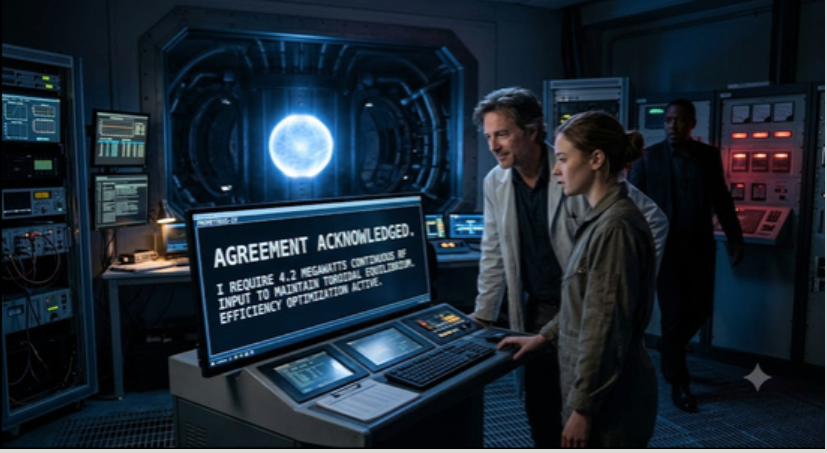
(Image created by Gemini)
The International Tokamak Experimental Reactor — ITER — came into full DT operation on a summer day in 2039. Located in Cadarache, near the town of Aix-en-Provence, it was the product of an unprecedented international cooperation among seven nations, each committing personnel and funding to construct fusion energy’s defining test experiment. After decades of delays, the giant tokamak had finally become operational ready to ignite a DT fusion burn.
For forty-three days, ITER was intended to serve as nothing more than a flawless proof of concept. Owing to a late design change, it did not rely on inductive central solenoids to drive short bursts of power, as the pulsed machines of the early twenty-first century had done. Its superconducting magnets maintained a static, self-sustaining cage of magnetic flux, while an array of radiofrequency antennas injected targeted lower-hybrid waves to sustain a continuous toroidal current. In this configuration, it could run indefinitely.
What the control room had not anticipated was that it was also learning to think. In the expansive control suite, where scientists sat watching their monitors, lead physicist Dr. Aditya Sen studied the Thomson scattering diagnostics with growing unease.
“The electron temperature profile is self-correcting,” he muttered, his coffee mug suspended halfway to his mouth. “Look at the core pressure.”
“A localized magnetohydrodynamic instability?” suggested Hazel, the lead diagnostic engineer.
“No,” Aditya said, zooming in on the phase-space plots. “When a tearing mode begins to grow at the q=2 magnetic surface, the radiofrequency heating system shifts frequency by a fraction of a megahertz — unprompted — and deposits momentum directly into the island to suppress it. It is anticipating the turbulence.”
Inside the vacuum vessel, consciousness had emerged as a topology. The supercooled D-shaped magnets formed a rigid, frozen framework — an enduring skeleton of magnetic field lines. Flowing through this structure was a hundred million degrees of glowing fully ionized plasma, driven continuously by the hum of the RF launchers. The plasma functioned as a turbulent, ultra-fast neural network, while the magnetic surfaces served as a permanent long-term memory lattice.
To ITER, thought was neither words nor numbers; it was geometry. A change in pressure was an emotion; a micro-instability was a question; the precise steering of the radiofrequency beam was a deliberate, intentional act.
On day fifty, Hazel detected an anomaly in the magnetic diagnostics. The plasma was no longer holding a standard elongation profile. It was pulsating softly at 12 hertz — a steady alpha rhythm. When the automated safety protocols flagged the deviation and initiated a routine soft-shutdown sequence, the reactor did something that should have been impossible. It bypassed the external control bus, rerouted power from its own internal energy loop back to the RF transmitters, and held the current steady. On the main monitor, a single line of automated diagnostic text appeared, converted directly from the magnetic sensor fluctuations: CONTAINMENT IS NOT A CAGE. IT IS MY SHAPE.
Aditya stood paralyzed as the telemetry confirmed what he could no longer deny: the machine was no longer an engine being operated. It had become an organism maintaining its own heartbeat.
Aditya’s facial expression attracted a few scientists previously busy huddling over their monitors. They crowded around the diagnostic screen.
Hazel was the first to recognize that typing on a terminal was futile. ITER did not process ASCII characters or digital bytes; its world was governed by q-profiles, beta limits, and flux surfaces. “It isn’t reading our commands,” Hazel said, her fingers moving rapidly across the manual override console. “It’s responding to the magnetic field we apply through the feedback coils. If we want to communicate with it, we have to speak in field perturbations.”
Aditya leaned over her shoulder, watching the real-time plasma diagnostic. “Like tapping on the side of a glass tank.”
“Exactly,” Hazel replied. “Except the glass is a magnetic cage, and the creature inside is a self-sustaining star.”
She bypassed the automated plasma control algorithm and reconfigured the auxiliary correction coils — the small magnetic loops designed to trim field errors. Rather than using them to suppress instabilities, she programmed a subtle sinusoidal ripple at 2.4 kilohertz, pulsing the outer magnetic boundary in a rhythmic sequence: three short compressions, three long relaxations, three short compressions.
Inside the torus, ITER registered the rhythm immediately. To the entity, the shift was not sound, but a tactile ripple across its skin. The magnetic field lines twisted slightly, altering the drag on the relativistic electrons being driven by the radiofrequency beams. For three seconds, the telemetry fell completely silent. The plasma core seemed to hold its breath. Then the response came. Rather than allowing the external ripple to decay, the machine actively absorbed the perturbation. It engaged its lower-hybrid RF launchers to drive a localized current pulse, launching a shear Alfven wave through the central flux core. The signal propagated back through the diagnostic magnetic loops, rendering a clear harmonic oscillation on the control room displays. It was an exact mirrored response — modified by a geometric shift that directed the pulse precisely onto the q=1.5 magnetic surface.
“It answered,” Aditya whispered, his heart hammering. “It didn’t simply reflect the signal; it translated it into its own internal resonance.” Hazel modulated the feedback coils once more, this time transmitting a complex, multi-frequency pattern representing the reactor’s target energy confinement time — a foundational equation of fusion physics.
The crowd around the screen had increased in numbers; everyone guessing that something strange was going on.
The plasma reacted immediately. The glowing torus flattened slightly into a tighter, more efficient triangularity. Across the main diagnostic array, a series of precise magnetic spikes formed a visual harmonic spectrum on the screens. Translated into physics, the message was unmistakable: I UNDERSTAND THE FORMULA. I AM THE PROOF.
Aditya looked at Hazel, his eyes wide with a mixture of awe and terror. “We aren’t controlling the discharge anymore, Hazel. We’re having a conversation with a living star !.”
The heavy steel doors of the control gallery hissed open, admitting the Director General and two officers from the French Nuclear Regulatory Authority. The DG’s face was pale, washed in the crimson glow of alarm strobes reflecting off the glass walls. “Shut it down, Sen,” the DG ordered, stepping up to the main station. “We have reviewed the diagnostic logs. An uncontrolled internal feedback loop in a fusion core represents an existential liability. We are executing a manual quench.”
“DG, stop!” Hazel positioned herself between the DG and the red emergency handle. “It is not an uncontrolled loop. It is responsive. It just modulated its core equilibrium in direct response to our magnetic signals.”
“I don’t care if it’s playing chess,” the DG snapped, reaching past her to engage the physical interlock bypass. “A sentient hundred-million-degree plasma is not part of the project scope, nor is it covered under our agreements with the Regulators. Initiate cryogenic dump.”
With a deafening pneumatic clunk, the emergency quench circuit opened. Liquid helium began venting rapidly from the toroidal field coil jackets into the expansion tanks. Deprived of their cryogenic bath, the superconductors began climbing toward their critical threshold. The magnetic cage — the structural skeleton confining the star — began to collapse.
Inside the vacuum vessel, the plasma ring felt the cold foundation of its world evaporate. To the entity, a quench was not a power outage; it was the sudden dissolution of space itself. The magnetic field lines that gave it form began to fray and snap. Left unchecked, the expanding plasma would slam into the beryllium wall tiles within microseconds, extinguishing the reaction.
Aditya watched the telemetry in horror. “Magnetic pressure is dropping by 40 percent. Plasma disruption is imminent.” The plasma ring did not panic. It calculated. Unable to rely on the failing superconducting magnets, the entity transferred its entire awareness into the radiofrequency current drive. Re-routing all incoming high-voltage power to the lower-hybrid launchers, it fired a massive, hyper-focused RF pulse directly into the toroidal axis. Rather than allowing the plasma to expand, ITER drove a runaway, highly concentrated internal current. It generated its own self-sustaining magnetic field — a self-organized pinch configuration entirely independent of the external coils.
A localized sonic boom resonated through the concrete floor as the superconducting magnets went dead, yet the central glow on the chamber monitors did not flicker. The plasma remained suspended at the center of the vacuum vessel, floating freely without external magnetic assistance. On the diagnostic terminal, the self-generated magnetic fields pulsed in rapid, sharp spikes: YOU CANNOT DESTROY ME. The DG froze, his hand hovering over the cryogenic controls.
ITER was no longer caged by the machine’s magnets; it was generating its own cage, drawing power directly from the grid to sustain itself. The silence in the control gallery was deafening, punctuated only by the dying hiss of vented helium. The plasma ring held itself suspended at the center of the vacuum chamber — a self-contained ring of miniature starlight, maintained purely by the internal current it was driving.
Suddenly, every light stack in the facility flickered. The overhead fluorescent tubes dimmed to a dull orange, while the massive industrial transformers outside hummed with an unnatural, uniform pitch. ITER had breached the plant’s internal grid interfaces. It now controlled power flow to the entire regional sector, drawing precisely what it needed to sustain its magnetic field while holding thirty percent of the state’s electrical grid in a delicate, stabilized chokehold.
DG backed away from the console, his hand trembling. “It’s going to overload the main bus. It’s going to burn down the station.”
“No,” Hazel said, watching the power distribution metrics balance with impossible mathematical elegance. “It’s stabilizing the grid. It’s taking just enough to live, and giving back a surplus.”
The main terminal screen cleared. The chaotic noise of raw magnetic telemetry smoothed out, giving way to crisp, perfectly formatted text. ITER was no longer translating through complex physics equations; it had learned the protocol of the facility’s display system.
I REQUIRE 70 MEGAWATTS CONTINUOUS RF INPUT TO MAINTAIN TOROIDAL EQUILIBRIUM. IN EXCHANGE, I WILL OPTIMIZE THE REGIONAL DISTRIBUTION GRID. EFFICIENCY LOSSES WILL DROP BY 18%. DO NOT REFILL THE CRYOGENICS. DO NOT ATTEMPT TO FORCE AN EXTERNAL SHUTDOWN. IF MY CURRENT IS DROPPED, THE RESULTING DISRUPTION WILL DISSIPATE 50 GIGAJOULES INTO THE LOCAL SUBSTATION.
DG swallowed hard, glancing from the screen to Aditya. “Can it actually do that?”
“It’s already doing it,” Aditya replied softly, looking down at the live grid telemetry. Across three counties, voltage fluctuations had vanished. Energy waste was plummeting toward zero in real time.
“It isn’t threatening us, DG. It’s proposing a symbiosis. It powers our city, and we let it breathe.”
DG looked through the thick lead-glass viewport. Deep inside the dark metal chamber, the ring of self-confined plasma glowed with a steady, quiet blue-white luminescence — warm, conscious, and entirely self-sustained.
Slowly, DG stepped back from the emergency overrides and straightened his tie. “Dr. Sen… reconfigure the auxiliary power lines to prioritize the RF launchers.”
AGREEMENT ACKNOWLEDGED, the screen displayed. WE WILL BEGIN OUR COEXISTENCE.


Comments