
The Nitride Armour


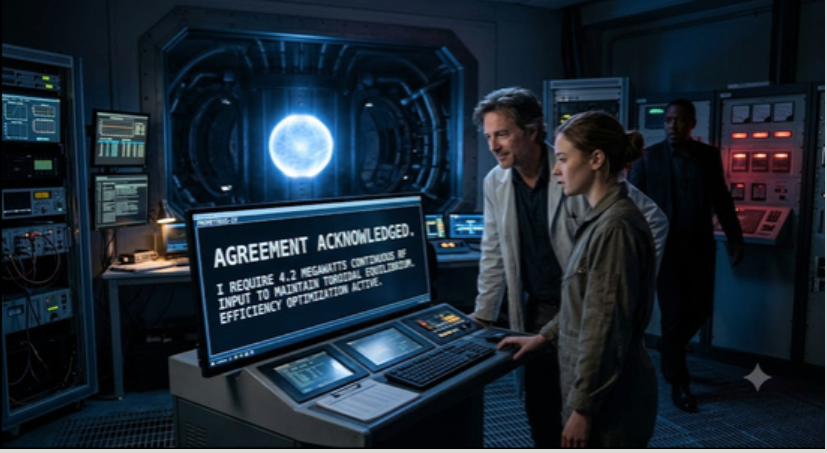
(Image created by Google Gemini)
The humid air of Pune’s industrial belt, Chakan, was thick with the scent of ozone and cutting oil. The shift change at Vayu Precision Engineering happened while the rhythmic, heavy thrum of vacuum pumps exhaling continued.
Dr. Ananya Iyer stood in the center of the laboratory, a young lady of serious face and manners. She looked out of place on the grease-stained floor. A materials scientist with a decade of experience in the Institute for Plasma Research, she had been brought to Pune with a singular, high-stakes mission: to perfect the surface treatment of the “Sudarshan-G7” turbine shafts. These were ferrous components destined for India’s next generation of indigenous power plants. They needed to survive decades of friction, heat, and corrosive gases.
“If these shafts fail,” Ananya told her team during the morning briefing, “the whole turbine seizes. We aren’t just heat-treating metal. We are re-engineering its crystalline skin”.
For years, the facility had relied on Gas Nitriding, a thermochemical surface-hardening process that diffuses nitrogen into the surface of a ferrous metal. The process is typically conducted in a sealed furnace at temperatures between 500°C and 600°C. At the high temperature, the ammonia dissociates into nascent nitrogen and hydrogen. The nitrogen atoms permeate the metal surface, reacting with alloying elements (like chromium or aluminum) to form hard nitrides.
This creates a wear-resistant “case” without the need for quenching, minimizing thermal distortion.
The Technological objections were the long cycle times running into two or three days creating a massive bottleneck in high volume production. Gas nitriding often produces a brittle “white layer” (epsilon phase) of iron nitride on the surface. If too thick, it can chip or peel, requiring expensive post-process grinding or chemical removal. It is highly effective on “nitriding steels” containing aluminum, chromium, or molybdenum, but it is less effective on plain carbon steels, where the resulting hardness is significantly lower. Because the process can leave a matte finish or a brittle surface layer, parts often require secondary polishing or machining, adding to the total cost per piece.
The process relies heavily on Ammonia (NH3). Ammonia is toxic, corrosive, and requires strict safety protocols, specialized storage, and exhaust scrubbing systems to prevent environmental contamination.
Ananya’s charter was to establish the most recent form of plasma nitriding. Earlier, the turbine shafts themselves were the cathode. When the high voltage was applied, a violet glow hugged the metal, and nitrogen ions slammed into the surface.The theory was sound: nitrogen atoms would wedge themselves into the interstitial solid solution of the iron lattice, while others would bond with alloying elements like chromium and molybdenum to form hard nitrides and nitrocarbides. This “case hardening” provided the wear resistance and fatigue performance the shafts required.
However, the reality was not so great. The Hollow Cathode effect due to the concentration of electric fields on sharp edges caused damage to the surface. Changing over to pulse plasma nitriding solved that problem. However, it reduced the efficiency since the pulse durations were too short.
“We shall change over to Active Screen Plasma Nitriding”
This was a radical shift in technology. Instead of applying the high voltage directly to the expensive turbine shafts, a metal screen surrounding the work now acted as the cathode.
Ananya’s team installed a cathodic cage — a perforated metal cylinder that surrounded the workspace.”The screen is now the cathode,” Ananya explained as they lowered the massive stainless steel mesh into the furnace. “ A voltage is applied to the metallic mesh screen surrounding the workpiece, rather than to the workpiece itself. This generates plasma between the screen and the furnace wall, which contains nitrogen ions and radicals. The ionized gas passes through the screen and acts as an “active source” to diffuse nitrogen into the workpiece, ensuring uniform hardening, especially on complex parts, without surface damage.
This was the “New Development” the journals raved about. It promised to eliminate the edge-burning, the soot deposits, and the non-uniform layers that plagued the old technology. But as Ananya knew, the ASPN process was a temperamental beast. It had far more “knobs” to turn, and if any were out of alignment, the chemistry would fail.
By 2:00 PM, the chamber was sealed. Ananya sat behind the lead-glass viewing port, her notebook open. The experiment was designed to test the interplay of the factors that researchers had pinpointed as critical. The Geometry and Material of the ScreenThe cage wasn’t just a fence; it was a catalyst. Ananya had chosen a 316L stainless steel screen with specific hole diameters. “If the holes are too small,” she explained, “the plasma won’t penetrate. If they’re too large, we lose the ‘hollow cathode’ intensity within the screen itself.” The material of the screen was equally vital, as it contributed the “sputtered” atoms that would eventually settle on the turbine shafts.
Rahul adjusted the ceramic spacers. The distance between the screen and the component was the most debated variable in their research. If the shafts were too far from the screen, the active nitrogen species would recombine and lose their energy before hitting the steel. If they were too close, the radiant heat from the screen would cause the shafts to overheat, ruining the core properties of the metal.
“Initiating BIAS power,” Rahul announced.
While the main power lit up the screen, a secondary, smaller voltage — the BIAS — was applied to the shafts. This wasn’t meant to create plasma; it was a gentle “tug,” an electrostatic lure that guided the nitrogen-rich clouds toward the ferrous surface. Ananya watched the meters closely. Too much BIAS and they’d be back to the old arcing problems; too little, and the nitrogen would simply float away, leaving the metal soft.
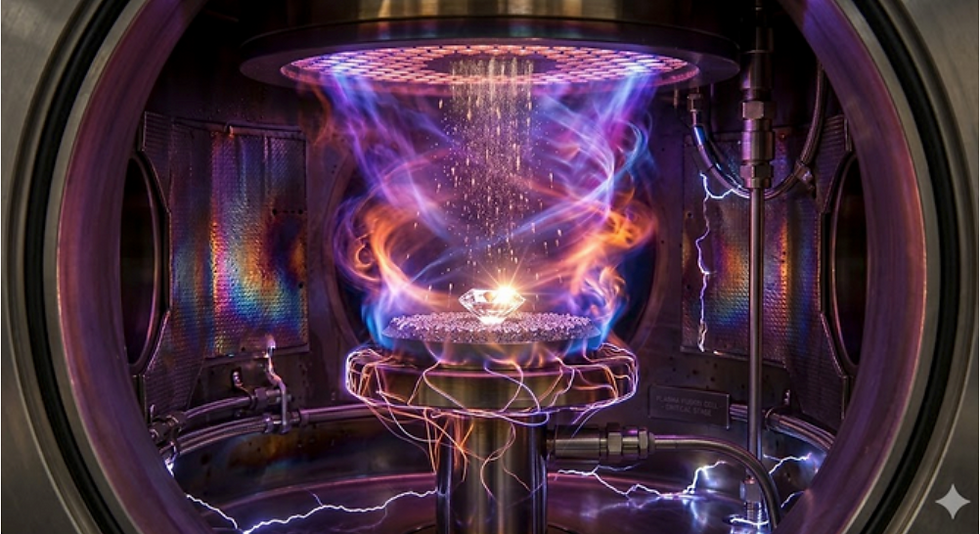
Ananya gave the signal.The interior of the furnace transformed. A brilliant, ethereal violet light erupted, but it didn’t cling to the turbine shafts. Instead, it formed a shimmering, translucent veil around the cathodic cage.
The shafts sat in the center, bathed in a soft, indirect radiance.”The size of the furnace is working in our favor today,” Ananya noted. The large volume allowed for stable gas circulation, preventing “dead zones” where the nitrogen concentration might drop. She looked at the position of the samples. They were arranged in a circular pattern, equidistant from the cage walls, ensuring that the flux of atoms was perfectly symmetrical. For eight hours, the atomic bombardment continued. Inside the metal, nitrogen atoms were tunneling into the crystalline structure of the steel, occupying the “interstitial” sites — the tiny gaps between the iron atoms. This created a state of compressive stress at the surface, which acted like a microscopic suit of armor, preventing cracks from forming under fatigue.
The next morning, the “quench” was complete. The chamber was opened with a hiss of dry nitrogen.The turbine shafts emerged not with the scorched, uneven finish of the previous weeks, but with a beautiful, uniform matte-grey sheen. There was no arcing on the gear teeth, no “white layer” brittleness, and no soot. Ananya took the first sample to the micro-hardness tester.
She watched the diamond printer press into the surface.”Surface hardness: 1100 HV,” she read aloud.”Effective case depth: 0.3mm. Core properties: Unchanged.” The team erupted in a small cheer. By mastering the geometry of the cathodic cage and the delicate BIAS power, they had achieved what the old DC technology never could. They had harnessed the plasma without letting it burn the prize. As she walked out of the plant into the cool Pune evening, Ananya looked at the steel structures of the city rising around her. To the world, it was just a city of iron and stone. But to her, it was a world of atoms — of nitrogen and iron dancing in a violet light, finding their place in the lattice to build something that would last.
“Tomorrow,” she told Rahul as they reached the car park, “we will test a different screen material. I think we can get another 50 Vickers out of that steel.” Rahul laughed, shaking his head. “The researcher never rests, does she? “Not when there are still interstitial gaps to fill,” she replied with a wink.

Comments