
The Fireball and the Mirage: Harvesting the Invisible River of Dhaneri


The sun over Dhaneri does not rise; it attacks.
In this small village perched on the jagged, arid lip of the Thar Desert in Rajasthan, the dawn is a pale, heat-muffled drumbeat. For decades, the rhythm of life here has been dictated by the “Matka Walk.” Before the first light can even turn the sand to gold, the women of Dhaneri — led by elders like 58-year-old Kamla Devi — begin a four-mile trek toward a brackish well that is more mud than mirage.
For Kamla, water has never been a utility; it is a weight. It is the ache in her cervical vertebrae and the permanent indentation on the crown of her head from years of balancing clay pots. But today, Kamla isn’t looking at the horizon for the well. She is looking at the roof of the village schoolhouse, where a series of shimmering, metallic plates catch the morning light like fallen pieces of the sky.
These plates are the result of a silent revolution in physics — a marriage between high-energy plasma science and the ancient survival instincts of the desert.
The Problem of the Invisible River
The Rajasthan desert is a paradox. While the ground is parched enough to crack bone, the air above it often carries a hidden bounty. Even in arid regions, the atmosphere holds a surprising amount of humidity, especially during the cool desert nights. The challenge has always been “harvesting” it.
Traditional atmospheric water generators (AWGs) are expensive, energy-hungry machines that rely on refrigeration cycles to cool air down to the dew point. In a village where electricity is a flickering luxury, such technology was a fantasy.
“We tried plastic sheets and nets,” says Dr. Arpan Seth, a scientist from the Plasma Research Institute who arrived in Dhaneri a year ago. “But the water would just cling to the surface in a thin, stagnant film. It wouldn’t run off. It would simply evaporate back into the heat before anyone could take a sip.”
This phenomenon is known as “filmwise condensation.” On a standard metal or plastic surface, water molecules bond too tightly to the material. They flatten out, creating a thermal barrier that actually prevents more moisture from condensing. To solve Dhaneri’s thirst, Arpan and his team had to look at the microscopic architecture of a lotus leaf.
The Fireball in the Vacuum
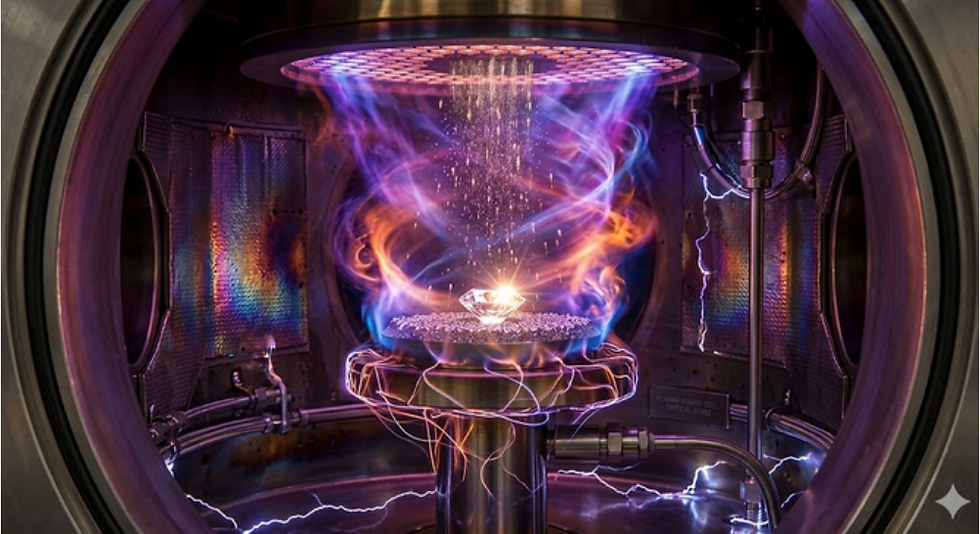
The breakthrough happened hundreds of miles away in a laboratory, inside a stainless-steel vacuum chamber. Using a process called Direct Current Magnetron Plasma Etching, researchers began to “sculpt” the surface of ordinary copper sheets.
Imagine a block of marble being chiseled by a sculptor, but the chisel is a beam of ionized Argon gas, and the sculptor is a purple “fireball” of plasma glowing at thousands of degrees.
By bombarding the copper with these high-energy ions, the scientists created a hierarchical nano-pattern. At a scale invisible to the human eye, the surface of the copper was no longer flat. It was a jagged forest of nanoscale peaks and valleys. When this surface was then treated with a thin hydrophobic coating, it became “super-hydrophobic.”
“The geometry is the secret,” Dr. Seth explains. “The water droplets can’t find a grip. They sit on top of the nano-peaks like a fakir on a bed of nails. Air stays trapped in the valleys below the droplet. This is what we call the ‘Cassie-Baxter state.’”
On these plasma-etched surfaces, water doesn’t form a film. It forms perfect, shimmering spheres. As soon as a droplet grows to a certain size, it loses its balance and rolls off at the slightest tilt, clearing the space for a new droplet to form. This is dropwise condensation, and it is nearly ten times more efficient than the old way.
The First Harvest
In Dhaneri, the implementation of this “Space-Age Copper” was met with deep skepticism.
“The elders thought it was magic or a trick,” says Vikram, a local youth who helped install the panels. “They asked, ‘How can a dry plate give water?’”
The system was simple: the plasma-etched copper plates were mounted on frames with a hollow back containing a phase-change material — a substance that stays cold from the night air and keeps the copper below the dew point well into the morning.
The first night the panels were active, Kamla Devi stayed awake. She sat in the courtyard, the scent of parched earth heavy in the air. As the desert temperature plummeted at 3:00 AM, the invisible river in the sky began to touch the copper.
On the nano-patterned surface, the molecules of vapor huddled together. Because of the plasma etching, they didn’t smear. They beaded. Tiny diamonds of water began to dance. Due to the lack of friction on the nano-peaks, the droplets began to merge and “jump.” This is a phenomenon known as coalescence-induced jumping — where the energy released when two droplets join is enough to literally fling them off the surface.
By 6:00 AM, a steady thrum-thrum-thrum echoed in the schoolyard. It was the sound of pure, distilled water hitting a collection trough.
That morning, the village didn’t go to the well. They went to the schoolhouse. Kamla Devi was the first to taste it. It didn’t taste of the salt and sulfur of the deep earth; it tasted of nothing. It was the flavor of the sky.
A Sustainable Blueprint
The success in Dhaneri has turned the village into a case study for the “Atmospheric Water Revolution.” The beauty of the plasma-etched surfaces lies in their durability. Unlike chemical coatings that peel off under the blistering UV rays of the Indian sun, the nano-pattern is etched into the metal itself. It is a structural change, as permanent as the grain in wood.
Furthermore, the process is “green.” There are no toxic liquid wastes — just the glow of the plasma and the recycling of argon gas. For a country like India, which faces some of the most acute water stress in human history, this marriage of physics and rural necessity is a lifeline.
Each panel in Dhaneri now produces about 15 to 20 liters of water per day during the humid months — enough for a family’s drinking and cooking needs. It has changed the economy of the village. The “Matka Walk” has been shortened. The girls of the village, who once spent their mornings hauling water, are now sitting in the very schoolhouse that harvests their water, studying the same physics that quenched their thirst.
The Quiet Change
As the sun climbs higher, hitting its zenith over the Rajasthan sands, the heat becomes a physical weight. The copper plates are now hot to the touch, and the harvest has ended for the day. The troughs are covered to prevent evaporation.
Kamla Devi sits in the shade of a Khejri tree. She no longer has the deep, chronic bruise on her shoulder from the water-jug straps. She watches the children play, splashing a few stray drops of sky-water on each other’s faces.
“The desert has always taken from us,” she says, her voice a low rasp. “The sun took our sweat. The wind took our soil. But now,” she gestures to the shimmering plates on the roof, “we are finally taking something back.”
The plasma fireball, a sun created in a lab, has given them a way to survive the sun in the sky. In the heart of the Thar, where life is a constant negotiation with the elements, the smallest patterns — measured in nanometers — have made the biggest difference. The invisible river is finally flowing into the cups of Dhaneri, one jumping droplet at a time.


Comments