
Farming with Plasma


Figure created by Google Gemini
The year is 2028, and Murugan was a man caught between the dirt of the past and the lightning of the future.
On his family’s acreage in the Kavery delta, the old, raised platforms of wooden planks covered with heavy duty tarpaulins to keep moisture seeping into and decomposing the manure had been replaced by something sleeker, stranger, and infinitely more temperamental: a Plasma-Assisted Ammonia Synthesis and Delivery System (PAAS-D). Murugan was the first customer the start up company led by Professors from the Puducherry University could attract. The promise was simple: “Green ammonia.” No more waiting for fertilizer from a far-away plant in Gujarat. Using a small-scale reactor on the farm, Murugan could pull nitrogen from the air and hydrogen from water, using a cold-plasma discharge to stitch them together into liquid gold for his crops.
But as Murugan stood in the edge of his plot, he wasn’t feeling like a pioneer. The PAAS-D unit sat on the back of his tractor, humming with a low-frequency vibration. In theory, the reactor used a dielectric barrier discharge (DBD) to break the strong triple bond of N2 molecules. In practice? The “ghost” was back. “Damn it,” Selvam, his brother shouted. “The discharge is flickering again. I’m getting a lean mix.”
Murugan mumbled. “Check your humidity, Selvam. If the air-intake is too wet, the plasma quenches. You’ll just be spraying expensive mist.”
Selvam looked at the sensor readout on the panel. The efficiency of the plasma catalyst was dropping. While the start-up had promised a high yield, the reality of field-work meant dust, fluctuating voltage from the solar arrays, and the sheer stubbornness of chemistry.
The delivery system was supposed to inject the freshly synthesized ammonia directly into the soil via a precision dispenser. To keep the ammonia stable without a massive cooling plant, the system relied on a delicate balance of pressure and temperature.
The sun had dipped behind a cloud bank, and his battery buffers were screaming. Plasma synthesis is energy-intensive; without 100% power, the nitrogen wouldn’t break.
“I’m losing the reaction,” Selvam muttered. He watched the glowing purple light in the reactor’s inspection port fade from a vibrant violet to a dull, sickly grey.
He hopped off the tractor, wrench in hand, though he knew a wrench was useless against a software-controlled ionized gas. He wiped grease from his forehead, looking at the paddy that was greener than any his father had ever grown.
That was the irony. When the system worked, it was a miracle. The crops were fed exactly what they needed, exactly when they needed it, with zero carbon footprint. But when it failed, Murugan wasn’t just a farmer with a broken tractor — he was a physicist with a broken lab, standing in the middle of a mud puddle.
“Selvam,” Murugan said, his voice softening. “If you can’t get the arc to stabilize, we will shut down and go. But the soil nitrogen levels are bottoming out.”
“Give it ten minutes,” Selvam. “I’m pushing a firmware patch to the electrode frequency. We’re going to try to ramp the pulse to shake off the electrode fouling.”
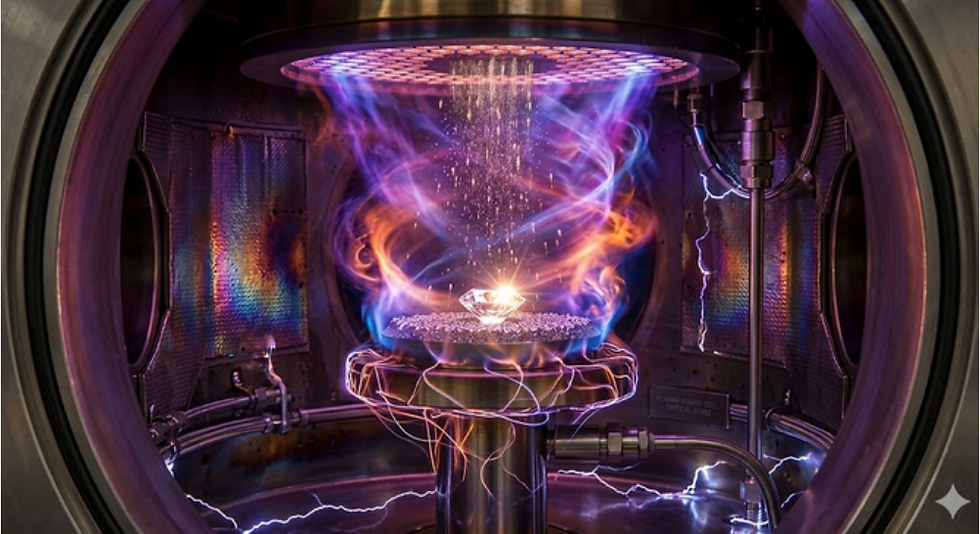
Murugan waited. The wind stirred the stalks. Then, with a sharp crack like a distant whip, the reactor surged. The purple glow returned, brighter than before — a miniature star trapped in a glass tube, turning the very air into life.
The hum leveled out into a satisfied purr. On the panel, the ammonia concentration climbed back to the target parts per million. “We’re back in business,” said Selvam. He watched the autonomous arm bury the injectors into the earth. It was a headache, a gamble, and a constant battle against the laws of physics — but as the sun set over the glowing purple reactor, Murugan knew he’d never go back to the old ways. He wasn’t just growing paddy anymore. He was harvesting lightning. “Minnal Valam!” Fertilizer from lightning.
To understand why Selvam was struggling with his “lightning in a bottle,” we have to look at the massive gap between traditional industrial chemistry and the localized physics of plasma.
Usually, ammonia (NH3) is made via the Haber-Bosch process, which requires massive pressures (200 atm) and high temperatures (450°C). That’s impossible to do it locally. Plasma offers a “shortcut” by using electricity to energize electrons rather than heating the entire gas.
The primary hurdle in making ammonia is the nitrogen molecule (N2). It is held together by a triple covalent bond — one of the strongest in nature. In Selvam’s reactor, a Non-Thermal Plasma (NTP) is created by a Dielectric Barrier Discharge. Instead of using heat to vibrate the molecules apart, fast-moving electrons collide with them, “kicking” them into an excited state or splitting them into highly reactive nitrogen radicals (N⋅) through the reaction
e−+N2→e−+N⋅+N⋅
Once the nitrogen is “split,” it can react with hydrogen (electrolysed from on-farm water) to form ammonia through the reaction: N⋅+3H⋅→NH3
While the theory is elegant, the fluid dynamics and electrodynamics inside a mobile reactor are chaotic. Here are the three main technical problems Selvam was facing:
The first problem was quenching: Plasma is extremely sensitive to “impurities” like water vapor. If the air is too wet, the energy from the electrons is absorbed by the water molecules instead of the nitrogen. This “quenches” the plasma, turning his purple glow into a dull grey and stopping the reaction.
Back-Reaction was another problem. Chemistry seeks equilibrium. In a plasma, as soon as NH3 is formed, a rogue electron can hit it and break it back down into N2 and H2. Selvam has to manage the residence time — moving the gas through the “spark” slow enough to react, but fast enough before the product is destroyed.
Electrode Fouling is another killer. Over time, the high-energy plasma can cause microscopic erosion of the electrodes by sputtering. This changes the gap distance, which fluctuates the voltage required to maintain the arc, leading to the “flickering”.
To drive deeper into why Murugan and the young farmers are obsessed with this technology, we have to look at the economics of farming. Presently, the Haber-Bosch process is the undisputed king of efficiency, but it has a problem. The theoretical minimum energy required to fix nitrogen into ammonia is about 0.4 MJ/mol. Haber-Bosch: Operates at about 0.5–0.8 MJ/mol. It’s incredibly close to the physical limit. Plasma-Assisted process currently ranges from 1.7 to over 50 MJ/mol. If plasma is so much less efficient, why is Murugan using it?
Because efficiency isn’t the same as cost. In 2026, the cost of ammonia isn’t just about the Joules used; it’s about where those Joules come from. Haber-Bosch requires a huge plant with constant, massive stream of natural gas (methane) for the hydrogen (H2) and expensive high pressure and heat.
Murugan’s Plasma Unit runs on renewable energy. When his solar panels produce more power than his farm needs, the electricity is essentially “free.” Using 10 units of “free” solar energy to make ammonia is cheaper than buying 1 unit of fossil-fuel ammonia and paying to transport it to the farm.
For a farmer, the price of fertilizer includes the “last-mile” tax. Ammonia is dangerous and expensive to transport. Murugan makes it where he needs it. He doesn’t have to store tons of explosive anhydrous ammonia in tanks over the winter. He makes what he needs for the afternoon’s run.
The biggest hurdle to the Plasma unit is Selectivity. In a plasma, electrons don’t just hit N2; they hit everything. If Selvam has even a tiny bit of oxygen in his system (a leak), the plasma will prioritize making Nitrous Oxides (NOx) instead of Ammonia (NH3). NOx is great for fertilizer too, but it’s acidic and can corrode his delivery lines. This is why his “lean mix” was such a problem — he was accidentally making “plasma-acid” instead of “plasma-fertilizer,” which could ruin his soil’s pH balance in a single afternoon.
This diagram provides a detailed cross-section of the specialized, modular system mounted on Murugan’s tractor, illustrating how non-thermal plasma (NTP) technology attempts to bypass traditional industrial requirements for fertilizer production.
The center of the diagram shows the Dielectric Barrier Discharge (DBD) reactor. A high-voltage pulse (10–30 kV) is applied to the central electrode. The purple zone is the Cold Plasma Discharge. Because the gas remains near ambient temperature, the energy selectively excites electrons rather than heating the entire gas stream. This is critical for mobile, localized operations.
The diagram separates the synthesis into two key stages to show where efficiency is lost or gained:
Stage 1: Dissociation: High-energy electron impacts break the Nitrogen triple bond (requiring massive energy) and the Hydrogen single bond. This creates highly reactive radicals.
Stage 2: Surface-Facilitated Synthesis: This is the critical, sophisticated part of the system. The diagram shows the radicals adsorbing onto a Functionalized Catalyst Coating (e.g., Ru/MgO on Alumina) lining the reactor. Without this catalyst, the radicals would likely recombine into N2 and H2 (the “back-reaction”). The catalyst facilitates the stepwise addition of hydrogen to the nitrogen atom (NH, then NH2, finally NH3), which reduces the energy needed for synthesis and improves yield.
The Dehumidifier and Filter on the air intake addresses the impurity problem. Air pre-treatment is mandatory because water vapour in the intake air will absorb the electron energy preferentially, “quenching” the plasma reaction and stalling ammonia production.
The output NH3 is separated and concentrated before being routed directly to the precision injection dispensers, which place the aqueous ammonia fertilizer directly into the soil root zone, minimizing volatile loss.
Note: This story is dedicated to researchers in Indian universities and IITs dreaming of making “Minnal Valam” available to Indian farmers

Kudos to your imagination! I wish that the dream of Researchers of Indian Universities and IITs will be fulfilled and to very soon!