
The Fourth State of Fashion

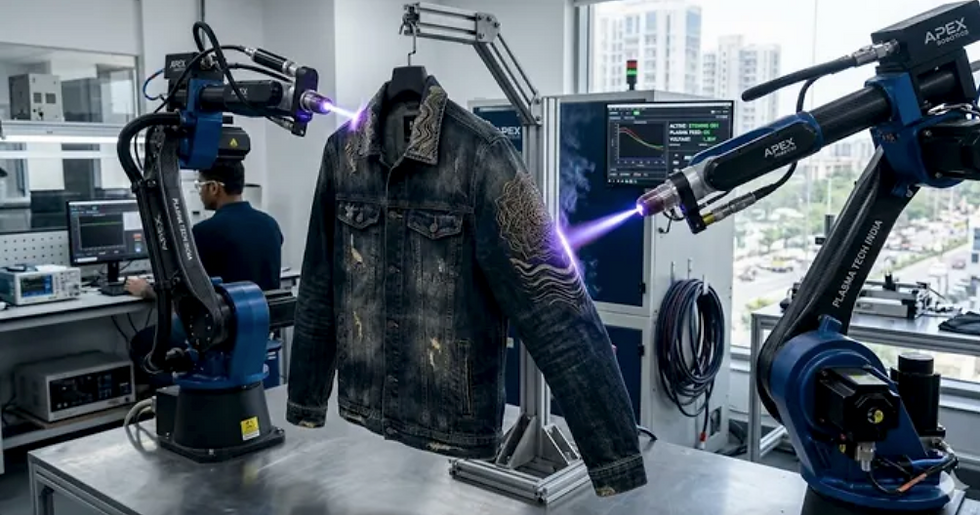
Image created by Google Gemini
In the colonnaded heart of Connaught Place, where the whitewashed Georgian arches met the high-tech sheen of the new millennium, the huge sign in burnished bronze said “Oxidize”. Next to that, through the heavy glass door, you enter the boutique. Here, the hum of high voltage instruments created a textured hiss that competed with the distant, rhythmic honking of the traffic in the Inner Circle.
Elias, the lead “Plasma Tailor,” moved with the grace of a Kathakali performer — deliberate, precise, and mesmerizing. In his hand, he held a sleek, carbon-fiber wand connected to a glowing umbilical cord that snaked back to a silent power rack. At the tip of the wand, a finger-length needle of violet light pulsed, crackling softly as it interacted with the humid afternoon.
Across from him sat Jassy, a scion of a Gurgaon tech empire who had traded his air-conditioned cabin for this high-tech studio. He leaned forward, watching the violet spark with the intensity of a devotee, clutching a pair of pristine, raw denim jacket that he had come to transform into something with a personality, a soul.
In the late 20th century, denim was pummeled by pumice stones in giant industrial washers to mimic the wear and tear of a decade of hard labor. It was a simulation of time. But Oxidize had moved beyond simulation into the realm of precision degradation.
“The ‘Vintage’ look is dead, Jassy,” Elias said, his voice a low, practiced purr. “Stonewashing is barbaric. It’s mechanical. It’s blunt trauma for fabric. Acid washing? That’s just chemical scarring. What we do here is atomic.”
Jassy leaned in, mesmerized. “And the personalization? You said you could etch the soul into the weave.”
Elias smiled. “Precisely.”
The violet glow of his applicator reflected his run in his eyes. “This is a brush. We aren’t just aging the fabric anymore; we are painting with the breath of the stars.”
Jassy watched as Elias brought the applicator tip within a centimeter of the denim jacket, which was draped over a high-tech mannequin. There was no contact, yet the fabric reacted instantly. Where the violet stream touched the navy blue, a faint wisp of white smoke rose — not from burning, but from the molecular sublimation of the dye.
“Atmospheric Pressure Cold Plasma,” Elias explained, his voice competing with the rhythmic shhh-shhh of the gas streams. “No vacuum pumps, no airlocks. We use a high-voltage radio frequency discharge to ionize a stream of oxygen mixed with helium. It’s a ‘cold’ flame. It won’t singe a hair on your arm, but it’s a chemical piranha for organic polymers.”
He gestured to a bank of robotic arms surrounding the mannequin, each fitted with its own needle-thin plasma jet.
“The old way was a blunt instrument. This is a surgical strike. Most people want ‘distressed.’ You want a ‘biography.
We’ve uploaded your ‘Kinetic Map’ — the GPS and accelerometer data from your smart watch for the last six months. These jets are programmed to hit the exact coordinates of your life. We know exactly where your elbows flex, where you lean against mahogany bars, where your phone sits in your pocket. The way your bag strap rubs your shoulder. The plasma will etch those specific stress points. In thirty seconds, we will give this jacket ten years of your life.”
“When those oxygen radicals hit your denim, they don’t just ‘wash’ it. They perform a microscopic surgical strike. They break the long-chain carbon polymers of the cellulose. They vaporize the indigo dye without touching the white core of the yarn. But here is where it becomes art.”
Jessy handed over his jacket to Elias, who arranged it over a frame. He flicked a switch, and the robotic array came to life. It looked like a high-tech loom from a fever dream. Half a dozen violet needles began to dance over the jacket, tracing invisible geometries.
“Watch the oxygen radicals,” Elias whispered. “They’re hitting the cellulose fibers at atmospheric pressure. They’re stripping away the indigo, breaking the covalent bonds of the surface sizing, and ‘micro-roughening’ the thread. It gives the denim that soft, sueded feel of a garment worn for twenty years in the sun.”
Unlike the uniform fade of a wash-cycle, the plasma streams created a chaotic, organic gradient. The violet light flickered as it encountered the ridges of the twill, leaving behind a “micro-etched” topography that felt ancient to the touch.
“We’re etching a quotation into the back panel: “Style is the dress of thoughts.” — Lord Chesterfield,” Elias noted. “Invisibly. The plasma is changing the surface energy of the fibers. When you walk out into the rain, the water will bead off the fabric everywhere except where the plasma has ‘written.’ The dampness will reveal the text. A temporary ghost in the machine.”
“We’re also functionalizing the surface,” Elias continued, moving his handheld wand to the cuff. “By varying the oxygen flow, I can make this specific patch of fabric super-hydrophilic. It will drink up moisture. Over here, I can change the chemistry so it rejects dirt. We aren’t just making it look old; we’re re-engineering the fabric’s relationship with the world.”
The air in the boutique grew sharp with the scent of ozone — the crisp, metallic tang of a mountain peak after a lightning strike. The robotic jets moved with frantic precision, “scarring” the back of the jacket with the clever quote about style. The text was invisible to the naked eye, etched only a few nanometers deep.
“In the rain, or when the humidity hits 80%, the quotation will bloom,” Elias said. “The plasma has changed the way the light refracts off the fibers in those specific shapes. It’s a haunting, Julian. Your clothes are haunted by your own data.”
As the last jet hissed into silence, the violet needles vanished, leaving only the soft glow of the boutique’s recessed lighting.
Elias lifted the jacket. It was no longer a mass-produced luxury item. It was a map. The elbows were pale and soft; the hem was slightly frayed with a precision that looked like the work of decades, not seconds.
Jassy ran his thumb over the collar. It felt like his favorite shirt from childhood — broken-in, compliant, and strangely warm.
“It’s the ultimate paradox,” Elias said, folding the garment into a recycled silk bag. “We use a stream of ionized gas at the cutting edge of physics to simulate the slow, temporal change of entropy, the decay of order. We’ve given you the dignity of age without the burden of the years.”
Jassy took the jacket out of the bag and wore it. He paid up for the treatment and stepped out into the warm New Delhi evening. As the city air hit the jacket, the microscopic etchings began to react, the fabric deepening in color where the plasma had kissed it. He looked like a man who had traveled a thousand miles on foot, all while standing perfectly still in the glow of a violet light.


Wonderful. Really loved reading this amazing blog! Looking forward to reading another good one soon.