
The Alchemist of Surat


The humid air of Surat usually smelled of salt and diesel, but inside the laboratory of Harishbhai Shah, it smelled of ozone and machine oil.
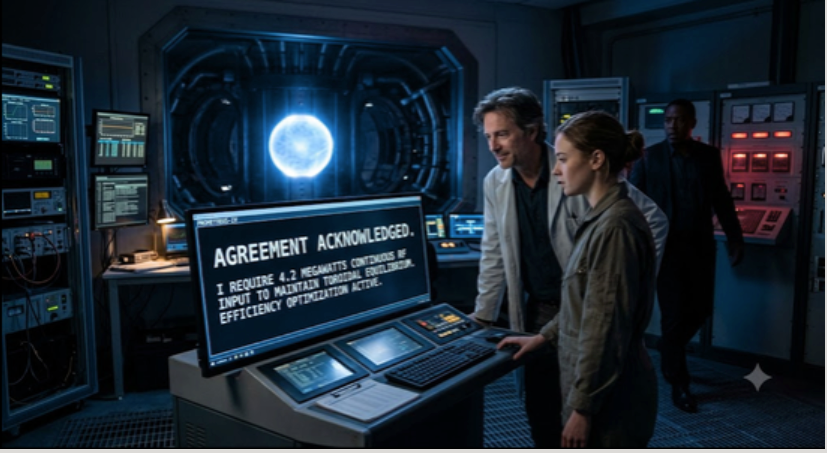
Harishbhai was not a traditional diamond merchant. He never sat on a white floor cushion with a magnifying glass, niggling over the clarity of a stone. He was a man of the machine. Specifically, a compact, affordable tabletop Plasma Wakefield Accelerator that occupied the basement of his nondescript laboratory in Ichchhapore.
Harishbhai was a dealer in the “untouchables”; the brown stones, the milky stones and the rejects that looked like dishwater turned into ice. The regulars at the Surat Diamond Bourse treated them as scrap.
He leaned against the glass partition, watching the vacuum pumps. Ankit, his nephew stood beside him. He had an engineering degree from Stanford and a permanent look of anxiety.
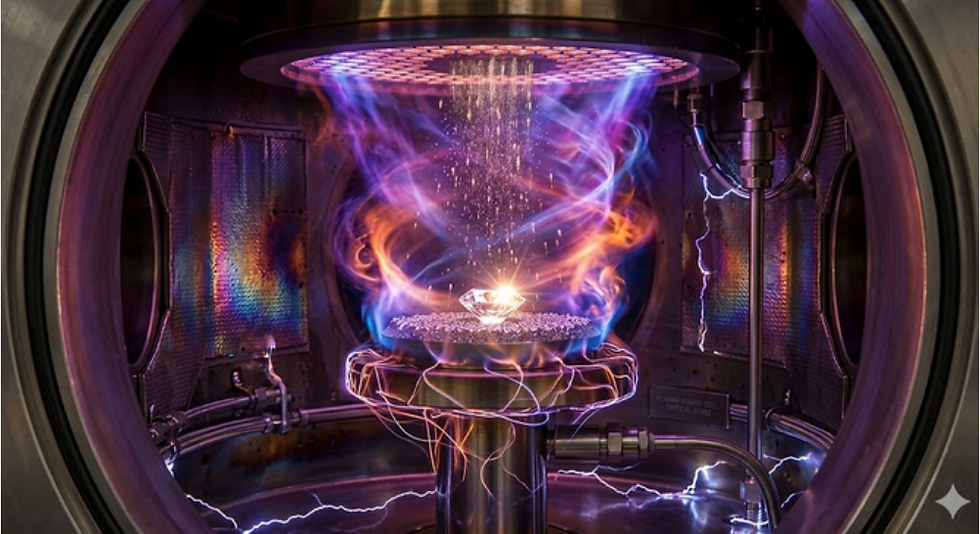
“Kaka, the nitrogen levels in this batch are inconsistent,” Ankit whispered. “If we treat them, we might get a muddy orange instead of the ‘Fancy Vivid Orange’ the client wants.”The process was ion implantation. Harishbhai’s lab used high-energy ions — boron, nitrogen, or hydrogen — to physically alter the crystal lattice of the diamond. By firing these particles deep into the stone, they could create “colour centres.”
A brown diamond, once bombarded with the right dosage of boron ions, could emerge as a deep, regal blue that would make a Tiffany’s executive weep.
“Start the cycle,” Harishbhai commanded.
The market for natural colored diamonds — pinks, blues, and greens — was skyrocketing because of their rarity. A natural five-carat pink could fetch millions. Harishbhai’s “treated” stones sold for a fraction of that, but his margins were astronomical. He bought the “trash” for pennies and sold the “treasure” for dollars.
He walked to his office, which had a framed photograph of his grandfather, who had started the family business with a single hand-operated polishing wheel. “The old man would think I’m a wizard,” Harishbhai mused, pouring himself a cup of masala chai. “Or a fraud.”
But Harishbhai was firm on ethics. Every stone that left his lab was laser-inscribed with a microscopic serial number indicating it was “Color Enhanced.” In the diamond world, the line separating the innovator from the criminal was very thin.
A knock at the door interrupted his thoughts. It was Vimal Bhai, a merchant who still believed that the only way to get a colored diamond was to pray for a miracle.
“Harish,” Vimal said, sitting down heavily. “The market says your ‘Ocean Blues’ are looking too good. The lab in Mumbai couldn’t distinguish the last batch from natural stones until they did a spectroscopic analysis.”
Harishbhai smiled, the corners of his eyes crinkling. “Only shows that I am better than nature, Vimal Bhai? Nature is chaotic. I am precise.”
Ankit shouted that the run was through. The load was a 15-carat monster — originally a dull, yellowish-grey stone that looked like a pebble from a driveway. Harishbhai had spent three weeks calculating the exact dosage of ions required to turn it into a b”right Canary Yellow”.
The physics was complex. To achieve the perfect hue, they had to manage the displacement of carbon atoms without shattering the diamond’s structural integrity.
The energy of the ions had to be precise. Too low, and the color would be a thin skin that polished off. Too high, and the diamond would “graphitize” — turning into an expensive lump of coal.
As the chamber hissed open, Ankit used titanium tweezers to lift the stone. It was covered in a thin layer of carbon dust from the high-energy impact. He dipped it into an acid bath, cleaned it, and placed it under the halogen lamp.
The stone looked like a piece of the sun; flawless. The ion implantation had worked deeper than ever before, creating a saturated, uniform gold that pulsed with “fire.”
The common belief is that a diamond’s value came from the millions of years it spent under the earth. But to Harishbhai, the earth was just a slow, inefficient furnace. He had compressed a million years of geological accidents into an hour long cycle with his high flux accelerator.
He was once asked if he felt that his work was dishonest. “If a rose is grown in a greenhouse instead of a wild forest, is it still a rose?” he had countered. “Does it smell less sweet? Does the person who receives it feel less love?” The value wasn’t in the dirt; it was in the delight.
His phone rang. It was Mr. Elias Thorne, a senior gemologist for a prestigious Swiss auction house. He had requested a private audience after Harishbhai’s company, ‘Surat Quantum Gems,’ had submitted three spectacularly saturated, emerald-cut ‘Fancy Vivid Green’ diamonds for the upcoming ‘Magnificent Jewels’ sale. Natural green diamonds are among the rarest treasures on Earth, typically created by millenia of natural radiation exposure near uranium deposits. These three stones, totaling twelve carats, were flawless in color uniformity.
Thorne’s face appeared on the screen. He sat in a white-walled examination room.
“Mr. Shah,” Thorne began, his tone polite but clipped. “Thank you for joining us. I will be blunt. Your stones are extraordinary. The color saturation is… frankly, unbelievable.”
“Nature is often unbelievable, Mr. Thorne,” Harishbhai replied smoothly.
“Indeed. But nature is also messy,” Thorne countered, tapping a pen on the desk. “We have subjected your greens to standard spectroscopy. The results are… ambiguous.”
“Irradiation usually leaves a very specific ‘GR1’ defect center in the crystal lattice,” Thorne explained, his voice becoming precise. “It’s a calling card. We can see it, and it tells us the color is artificial. Your stones do not have the GR1 defect. They look natural.”
Harishbhai felt a spike of pride. His nephew’s proprietary annealing process — heating the stone after the ion bombardment to heal the lattice damage while locking in the color — was working.
“However,” Thorne continued, “a specialized photoluminescence scan showed an unusual spike in the vacancy-related defect centers. It’s too uniform. It doesn’t look like accidental geology.”
Harishbhai leaned forward, placing his elbows on the desk.“Mr. Thorne, you are correct. Those diamonds did not come out of the earth green.”
The admission hung in the air. Thorne paused, his expression unchanged. “Then, by the regulations of the World Jewellery Confederation, we must label them as ‘Treated.’ Their value will collapse by 90%.”
Harishbhai smiled. “Tell me, Mr. Thorne. The green color. Is it stable?”
“We tested for color stability under extreme UV light and high temperature. Yes. It is permanent.”
Harishbhai nodded. “I am not presenting these as natural. I am presenting them as engineered.”
“Engineered?” Thorne repeated, raising an eyebrow.
“The world’s supply of naturally coloured diamonds is vanishing. What you see on your desk is a brown, ugly stone that was worthless to your traditional clients. We did not cover it with paint, Mr. Thorne. We didn’t laser-drill it to remove inclusion. We finished what nature started.”
Harishbhai paused to let the words sink in.
“We implanted directly into the lattice. We changed the diamond at an atomic level to reflect green light. This isn’t ‘treatment’ like heating a sapphire. This is nanotechnology applied to carbon.”
“The market demands rarity,” Thorne said, playing devil’s advocate.
“The market demands beauty and certainty,” Harishbhai countered, his voice gaining strength. “A natural vivid green might have structural weaknesses, or an unknown history. My Quantum Greens are perfect. They are consistent. And they can be inscribed and traced back to my lab. I provide certainty of origin and quality.”
“Mr. Shah, the old guard in Antwerp will be furious.”
“They were furious when laser-inscription of serial numbers started. They will adapt. You are an auction house. Your job is to find value where the world hasn’t seen it yet. I am offering you an exclusive portfolio: ‘The Ion Series.’ The world’s first scientifically optimized, stable, vividly colored diamonds. The labels will say ‘Color Enhanced by Ion Implantation. We hide nothing.”
Harishbhai sat back, taking another sip of his cold tea.Thorne stared at the three green gems glinting on the velvet tray. He saw not only their beauty but the inevitable future. Traditional supply was a dead end. This Gujarati businessman, sitting thousands of miles away, had solved the supply crisis with a particle accelerator.
“If we label them explicitly as ‘Quantum Enhanced,’ and focus the marketing on the precision engineering aspect, as ‘diamonds for the 21st century’…” Thorne mused aloud.
“The 21st century, Mr. Thorne,” Harishbhai smiled, “is about taking control of nature, not waiting for it.”
Thorne nodded once, decisive. “We will accept the stones. ‘The Ion Series’ will be a featured collection in the ‘Science of Beauty’ section. I believe your calculated risk might just redefine the auction block, Mr. Shah.”
Harishbhai ended the call. He texted Ankit. “Prepare the 20-carat rough. We are attempting ‘Fancy Vivid Pink.’ The world is ready.”

Comments