
Stories From the Fourth State

On 21 August, 2026, my collection of stories on plasma mediated applications appeared as a Kindle book on the Amazon site. This was my first book published on Kindle. Check out the site:
I started writing on Medium in 2021. For years, I chronicled my journey from being a curious student to a seasoned plasma scientist. I wrote about the pleasure I derived from building plasma devices — from the commonplace glow discharge to the magnificent ADITYA tokamak and from intense electron beam generators to electron clouds trapped in torii. I wrote about the 5th floor laboratory in the Physical Research Laboratory in Ahmedabad, the wide corridors of the Institute for Plasma Research in the Bhat Village, the crisp, and intellectual air of the International Atomic Energy Agency in Vienna.
After five years and gaining close to 4000 followers, the well went dry. I found myself staring at a blank screen, wondering if there was anything left to say.
Then, I remembered the incident that triggered my desire to look for practical applications of the fourth state. I was pointing out the engineering features of ADITYA tokamak while it was being assembled to Prof S Ramaseshan,, the former director of IISC and a member of the IPR Council. The main shutter to the hall was open and a cowherd walked in: the IPR campus used to be grazing land for cattle . He was staring at the huge machine with its magnetic coils, vacuum vessel and the humming overhead crane with disbelief.
Prof Ramaseshan looked at him and then turned to me and asked “John, how do you think this machine that you are building affects this man?”. I understood what he meant and on the spur of the moment decided that I would start working on some down to earth applications of the plasma state that may benefit ordinary people.
Recalling that incident, I realized I hadn’t stopped having stories to tell; I had simply stopped looking at where the science had gone after it left the lab.
I remember the first time I saw the hydropower components eroded by silt in the Himalayan rivers: as if some beast had gnawed at it again and again. I realised the value of plasma nitriding when the NHPC engineer assured me that they would be saving millions of rupees every year if I could make the steel harder than quartz; which we did. When a scientist from the Wool Research Board explained the trouble with the beautiful, soft and warm Angora wool because it was too smooth for spinning together to form a thread. We bombarded the surface of the yarn with ions and changed its topography, creating microscopic scale-like structures that gripped one another. It was a revolution for the artisan. A weaver in a remote village could now spin the yarn with ease, turning raw luxury into a viable livelihood. It wasn’t just physics; it was the restoration of a craft.
When we synthesized silica coatings on polished brassware using plasma, the real magic was in the preservation of beauty. A thin, invisible shield of glass-like material, applied atom by atom, locked the brass in a state of eternal brightness. It didn’t just save time; it allowed families to cherish their heritage without the slow decay due to the elements. Dr Chidambaram, the Chairman of the Department of Atomic Energy heard about this and wanted me to coat a brass replica of the Shiva thandava, a gift to the Director General of IAEA.
The story about the delivery of clean water to a Rajasthan village is based on work done by my colleague Dr Mukesh Ranjan.
The story of in-situ ammonia for farming was inspired by a project on cold plasma synthesis of Ammonia being pursued by Dr Suraj Sinha at the Pondicherry university. On his insistence, I have accepted the role of honorary Principal Investigator and we exchange ideas on this project. I am convinced that the project would make an impact on the agricultural scene. The farmer no longer need to rely on a global supply chain; they rely on the chemistry of the atmosphere itself. It is a quiet, local, and sustainable miracle.
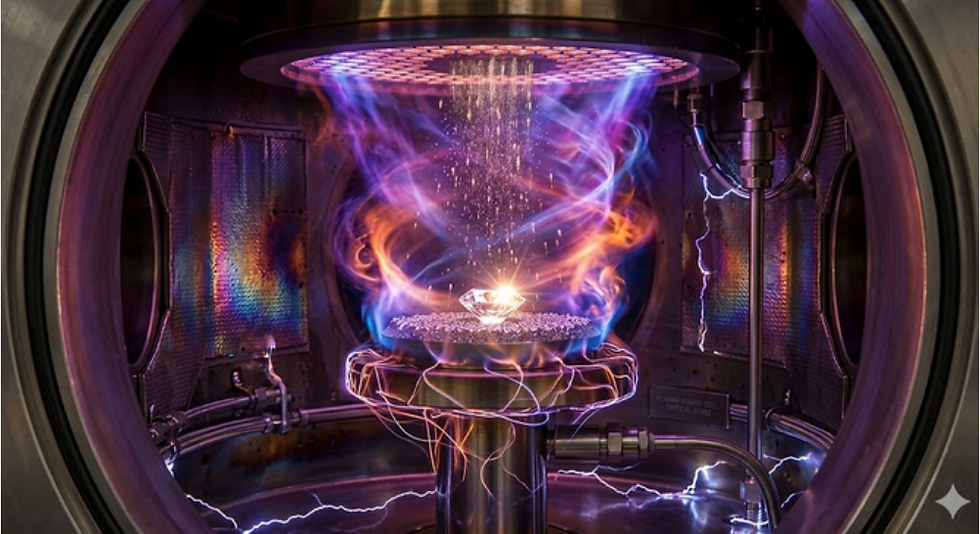
As I look back on those 150 autobiographical stories of my career, I realize they were merely the prologue. The true story of my life’s work isn’t found in the halls of the laboratory or the blueprints of the tokamak. It is found in the soft texture of a sweater, the un-tarnished glow of a brass lamp, the spark of a treated diamond, and the lush green of a field fed by the air itself.
Plasma didn’t stay in the lab. It walked out the door, into the fields, the workshops, and the homes of everyday people. And that, I believe, is a story that never really ends.

Comments