
Harvesting the Sun


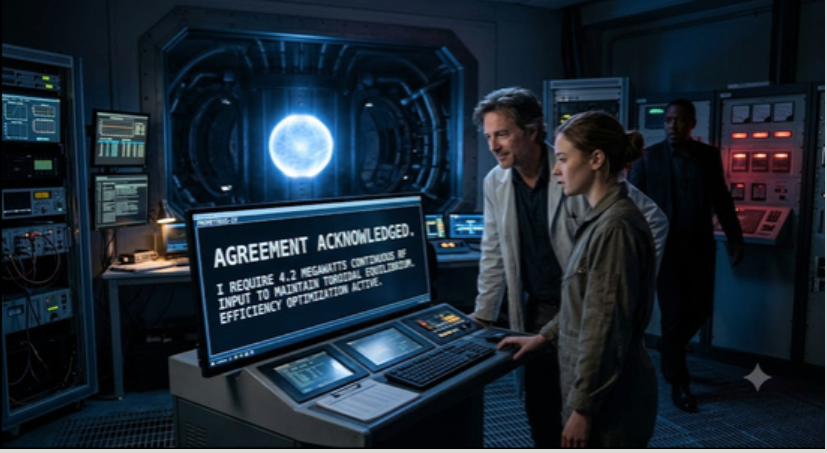
(Image created by Google Gemini)
The desert heat outside the IonSynth Plasma Technologies was merciless, but inside the Control Room, the tension was cold enough to bite. Dr. Kavya Nair stared at the digital telemetry wall, where red alert banners pulsed in rhythmic sequence. Out on the salt flats, huge arrays of photovoltaic panels were producing a massive surge of clean electricity that the regional grid could not absorb. Battery banks across the district were already saturated, their limited capacity exhausted by midday. Without a way to convert that overflowing power into storable energy, the system operator would be forced to disconnect the solar arrays — wasting gigawatt-hours of zero-carbon power while fossil-fueled plants waited in the wings to take over the evening load.
Kavya rubbed her eyes, feeling the weight of the Ministry’s impending deadline. The directive that gave Government financial support to her startup was clear: India needed dense, transportable chemical fuels. Methane and methanol could be pumped through thousands of kilometers of existing steel gas pipelines at a fraction of the cost of building new high-voltage electric transmission lines. The Power-to-Gas scheme was the ultimate goal for long-term, mega-scale energy storage. But between the ambient solar power outside and a usable synthetic fuel lay a single, stubborn molecular adversary: carbon dioxide.
Inside the central containment bay stood Kavya’s creation — a custom-engineered plasma-chemical reactor module. Her strategy relied on recycling CO2 captured from power plant flue gases, mixing it with green hydrogen generated via solar water electrolysis, and splitting the carbon dioxide to produce synthetic hydrocarbons. If successful, the process would close the carbon cycle entirely, establishing a net-zero equilibrium that mimicked the Earth’s natural carbon dynamics. But right now, the reactor is failing.
“Temperature spike in the primary discharge zone! Gas temperature has crossed 4,500 Kelvin!” yelled Abin, her lead diagnostic engineer, his fingers flying across the console. “We are losing non-equilibrium conditions again, Dr. Nair!”
Kavya lunged toward the monitoring screen. The live optical emission spectra showed a disastrous shift. Instead of a controlled discharge, the plasma inside the chamber had thermalized into a brute-force arc. High-energy electronic state excitation was tearing through the gas stream, demanding an absurd 9 electron volts per molecule to break a single carbon-oxygen bond. The bulk gas was heating up uncontrollably, plummeting the overall energy efficiency to a dismal 14 percent.
“Shut it down!” Kavya ordered, slumping back into her chair as the low hum of the power supplies died away.
Silence filled the control room, punctuated only by the distant hum of the cooling fans. This was their ninth failed attempt this month. If they couldn’t demonstrate a viable, energy-efficient path to CO2 dissociation, the project’s funding would be reallocated to conventional, catalyst-heavy direct hydrogenation units — systems reliant on scarce, imported noble metals like platinum and ruthenium that made large-scale deployment economically impossible.
That night, long after her team had left the complex, Kavya remained in her office surrounded by printed spectral plots and quantum state diagrams. She traced the structural geometry of the carbon dioxide molecule on a whiteboard: a linear, dumbbell-shaped triatomic structure.
Why are we trying to smash it with sledgehammers? she thought, tapping her marker against the board.
Standard thermal cracking required extreme temperatures because it treated the molecule like a rigid brick, forcing electrons into high electronic states. But the dumbbell-shaped molecule possessed rich internal degrees of freedom — specifically, its vibrational modes. If she could selectively channel energy into the molecule’s asymmetric stretch vibration via electron impact, she wouldn’t need 9 or 10 eV. The symmetric linear geometry allowed energy to transfer between colliding molecules in a step-by-step cascade: vibrational-vibrational collisions.
It was the quantum mechanical equivalent of pushing a child on a swing. You don’t launch them over the bar in one massive, violent shove; you apply small, perfectly timed pushes that build amplitude until they reach the top. If the electrons in the plasma possessed just the right energy distribution, they could trigger a “ladder-climbing” process, incrementally populating higher vibrational levels until the C=O bond naturally snapped at its fundamental thermodynamic limit: exactly 5.5 eV.
To make that ladder-climbing process work at high throughput, the plasma had to operate in a precise, delicate regime — a warm plasma operating directly at the parameter boundary between cold non-thermal discharges and hot thermal plasmas. It needed high electron density to sustain fast vibrational excitation, but the bulk gas temperature had to be held strictly between 2,000 K and 3,000 K to prevent thermal quenching from destroying the vibrationally excited states before they could dissociate.
The next morning, Kavya gathered her team around the disassembled reactor core. “We are changing the discharge architecture,” she announced, her voice filled with quiet determination. “We aren’t using a static thermal arc anymore. We are going to use a dynamic Gliding Arc source”
“The gliding arc will sweep through the gas to produce nonequilibrium plasma with an elevated gas temperature of 2,500 Kelvin. This will accelerate chemical kinetics without letting the translational heat run away. We are going to force the molecules up the vibrational ladder.”
For three agonizing days, the team worked around the clock, reconfiguring the plasma source, retrofitting the magnetic arc swirl nozzles, and recording the real-time feedback loops.
By Thursday afternoon, the sky above the Thar was clear, and the solar array was once again generating maximum power.
“Power grid interface online. Surplus solar feed locked at 50 Megawatts,” Abin announced, his voice tense. “Gas feed from tanked CO2. Initiating warm plasma discharge in three… two… one…”
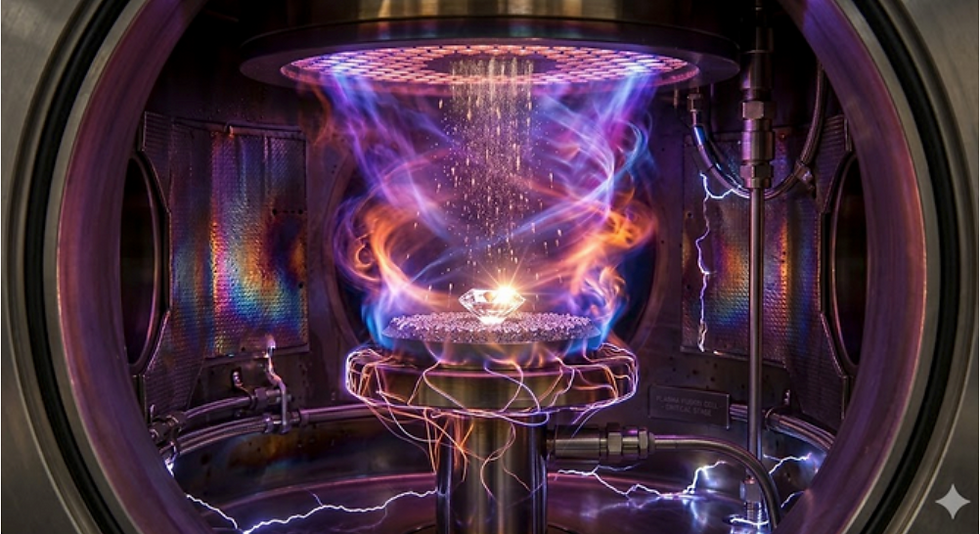
A brilliant, violet-gold glow ignited inside the quartz viewing port of the reactor. Unlike the harsh, blinding white arc of their earlier tests, this discharge hummed with a stable, swirling vortex.
Kavya watched the telemetry wall like a hawk. “Report electron temperature and gas temperature!”
“Gas temperature holding steady at 2,450 Kelvin!” Abin shouted. “Electron energy distribution function is peaking precisely in the 1 to 2 eV range — optimal for vibrational pumping!”
“Spectroscopy confirms vibrational state population!” another engineer called out, her voice rising in excitement. “V-V collisions are dominating the kinetic pathway! The ladder-climbing process is active!”
On the live mass spectrometer display, the sharp peak corresponding to molecular carbon dioxide began to plunge, replaced instantaneously by massive signals for carbon monoxide and singlet oxygen. The dumbbell molecules were marching up the vibrational ladder and snapping cleanly at the 5.5 eV threshold.
“Energy efficiency?” Kavya asked, holding her breath.
The automated diagnostic computer calculated the thermodynamic conversion ratio, averaged over the volumetric throughput. A bold green number flashed on the main wall: 59.8%.
“Nearly 60% energy efficiency!” Abin cheered, slamming his fist on the desk in triumph. “Power density is locked at 45 W/cm³! And zero catalyst degradation because there is no catalyst!”
Kavya felt a wave of relief wash over her. She stepped up to the control panel and engaged the secondary synthesis loop. The plasma-dissociated carbon monoxide stream merged instantly with the solar-generated green hydrogen. Downstream sensors showed synthetic liquid methanol and high-purity methane pouring into the facility’s output storage tanks.
Looking out through the control room glass at the endless solar arrays stretching toward the horizon, Kavya smiled. She was literally harvesting the Sun to transform a dangerous atmospheric pollutant into the lifeblood of a zero-emission circular economy. India had not just solved its renewable storage bottleneck; it had mastered the physics of non-equilibrium warm plasma to do this.

Comments