A New Radiance for Moradabad

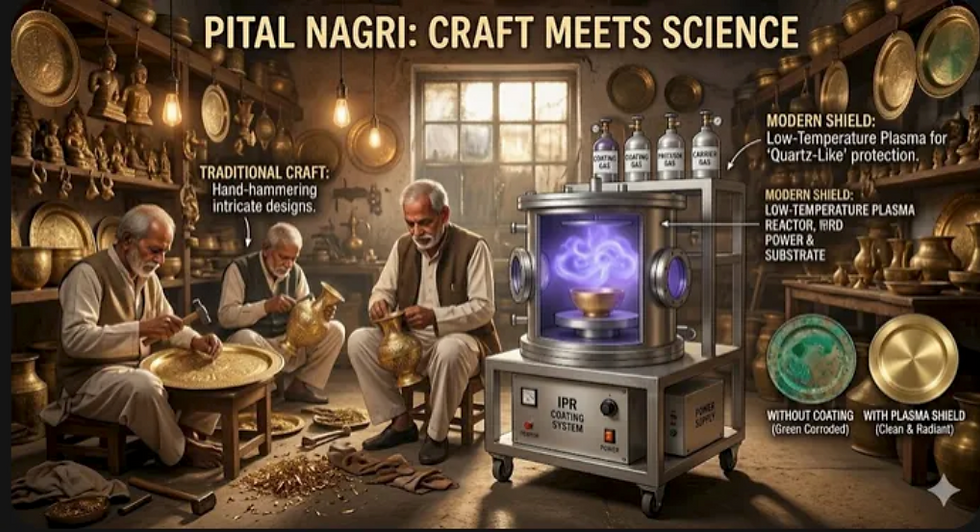
The air in Moradabad is a heavy soup of coal smoke and metal dust. The ghosts of a thousand years of craftsmanship hide in the street corners. To a stranger, the noise of the “Pital Nagri” — the Brass City — is a chaotic din. But to Salim, the rhythmic tink-tink-tink of hammers hitting metal was like a heartbeat. It was the sound of his grandfather shaping prayer lamps for temples, and the sound of his father crafting ornate vases for the mansions of Delhi. The narrow, soot-stained lanes of Moradabad have hummed with the rhythmic tink-tink-tink of hammers for centuries. Here, brass isn’t just an alloy; it is the lifeblood of the city.
Brass is a proud but temperamental metal. It mimics the glow of gold, offering a warmth that steel and aluminum can never replicate. However, its beauty is fleeting. In the humid, sulfurous atmosphere of industrial Moradabad, a freshly polished piece of brass begins to die the moment it is finished.
For Salim, a third-generation craftsman, the metal was a fickle friend. He could shape it into a masterpiece — a delicate Aftaba or a grand vase — but he knew that the moment it left his workshop, the air itself began to steal its glitter. The humid breath of the monsoon and the sulfur of the city’s hearths would inevitably turn the radiant gold into a weeping, dull green.
Salim stood in his workshop, looking at a shipment of intricate Aftabas — traditional long-necked water vessels — destined for a boutique in Paris. They were radiant now, but he knew the cycle. Within weeks, atmospheric oxygen and moisture would react with the copper in the brass. The golden surface would first turn a sickly yellow, then a dull brown, and finally, a weeping, crusty green.
“The foreigners want the glow, Salim, but they do not want the work,” his father had warned him years ago. To keep brass shining, it required constant polishing with Brasso or lemon and salt. In a modern world of “set it and forget it” home decor, Moradabad was losing ground to cheap, plastic-coated imitations from factories that lacked soul but offered “permanence.”
To keep the luster alive for the international market, artisans relied on traditional lacquers that often chipped or dimmed the metal’s natural fire. Lacquer — a thick, organic coating acted like a clumsy plastic wrap. It was thick, often dripping into the fine engravings and blurring the sharp lines of Salim’s chisels. Worse, if a single tiny scratch occurred, the moisture would seep underneath, creating ugly, dark “spider webs” of corrosion that could never be cleaned.
Atmospheric corrosion wasn’t just a chemical reaction; it was an economic barrier. In the global market, “maintenance-free” was the mandate. If Moradabad’s brass couldn’t stay bright on a shelf in London or New York, the industry — and Salim’s livelihood — would tarnish along with it. Salim’s craft was at a crossroads. He was a master of the 17th century trying to survive in the 21st.
The change didn’t come from a new hammer or a different alloy. It arrived in the form of a team from a research institute, based far away in Gandhinagar. They didn’t look like craftsmen; they looked like astronauts of the laboratory. They were invited by the Moradabad Brassware Industry Association. They didn’t bring polish or wax; they brought a piece of the sun.
When the institute set up their treatment facility in the heart of Moradabad, the local artisans were skeptical. “They say they use the fourth state of matter,” Salim whispered to his neighbor, Yunus. “They say they can wrap our brass in a layer of stone that you cannot even see. The solution was Plasma Polymerization. Inside a vacuum chamber, the scientists created a low-temperature plasma — a glowing, ionized gas. They introduced specialized monomers that, under the influence of the plasma, shattered and reassembled themselves into a “quartz-like” thin film. Not a thick, gooey coating; but a transparent, nanometer-scale shield, as hard as glass but as flexible as the metal beneath it.
The scientists explained the concept of Plasma Polymerization. To Salim, it sounded like alchemy. They spoke of vacuum chambers and ionized gases, of molecules being shattered by electricity and rebuilt into something new.
The goal was to deposit a “quartz-like” layer — technically a silicon-oxide-based film — onto the surface of the brass. Unlike lacquer, which sits on the metal, this plasma-deposited film would be nanometers thin, chemically bonding to the brass at an atomic level. It would be as hard as glass but as flexible as the metal itself.
One Tuesday, Salim took his finest piece — a large, hand-engraved platter featuring the Tree of Life — to the IPR facility. He watched as the technician placed it inside a heavy stainless steel vacuum chamber.
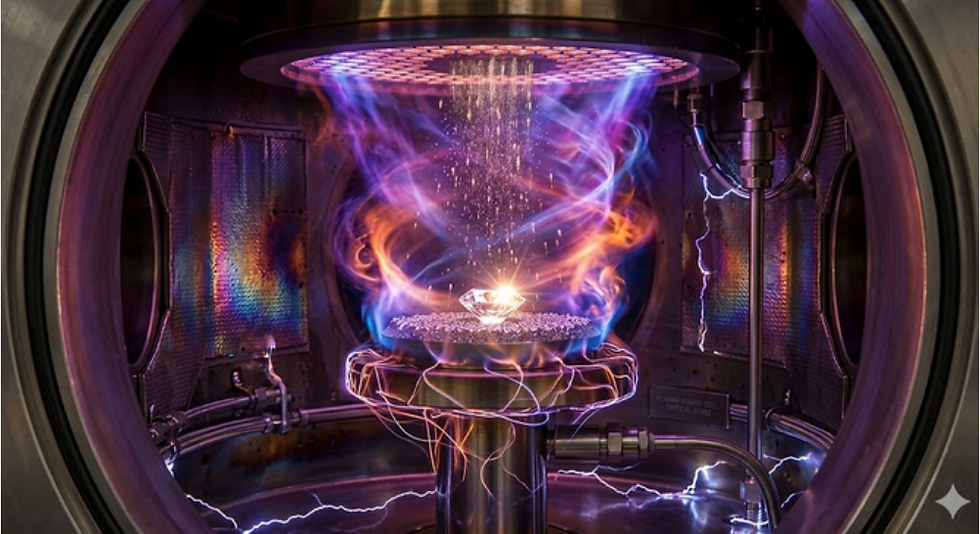
As the pumps hummed, removing the air, the technician turned a dial. Through a small glass porthole, Salim saw a miracle. The interior of the chamber didn’t just light up; it glowed with a ghostly, violet-blue radiance. This was the plasma — a swirl of high-energy electrons and ions.
Inside that violet glow, a specialized precursor gas (a monomer) was being broken apart. The plasma acted like a cosmic construction crew, taking those fragments and knitting them together directly onto Salim’s platter. In a matter of minutes, the “star-fire” inside the machine had grown a transparent shield of quartz over every microscopic ridge and valley of his engraving.
When the chamber hissed open and the platter was handed back to him, Salim blinked in confusion. To the naked eye, it looked untouched — the raw, buttery glow of the brass was perfectly preserved. “You didn’t do anything,” he remarked, running his thumb over the metal. “It looks exactly the same.” Unlike lacquer, this quartz-like layer didn’t peel. It was chemically bonded to the surface.
The scientist smiled. “That is the point, Salim. It looks the same, and it will look the same forever.”
To prove the power of the technology, the IPR team conducted a “torture test.” They took two identical brass bowls — one untreated and one protected by the plasma-polymerized quartz film. They sprayed them with a concentrated salt-water solution, mimicking the salty air of a coastal city or the harsh sweat of human hands.
Days later, the untreated bowl was a disaster of mottled grey and green spots. The plasma-treated bowl, however, sat on the table like a defiant sun. It was as brilliant as the day it was forged.
Salim realized this wasn’t just a technical upgrade; it was an economic revolution. For the first time, Moradabad’s brass could compete with the “stainless” industries of Europe and China. It could be sold in New York or London with a “Lifetime Glow” guarantee.
Word spread through the lanes of the city. The skepticism turned into a queue. The treatment facility became a bridge between the ancient and the futuristic.
Suddenly, Moradabad wasn’t just competing on price; it was competing on technology. Their brass could now withstand salt spray and industrial pollutants. For artisans like Salim, it meant their art was finally permanent. A piece sold today would look the same decades later, preserving the craftsman’s “signature” against the ravages of time.
The treatment facility in Moradabad turned a local struggle into a global advantage. By wrapping ancient art in the protective embrace of 21st-century physics, the “Brass City” ensured that its golden heritage would never fade. Salim no longer fears the air; he knows that his hammers create the shape, but the plasma preserves the spirit.
For Salim, the impact was deeply personal. He began to see his work differently. Before, he felt he was creating a transient beauty — something that would eventually fade and be hidden away in a cupboard. Now, he was creating heirlooms.
He recently completed a set of brass lamps for a hotel in Mumbai. He watched them being packed, knowing they would hang near the sea, exposed to the salty breeze that had ruined his father’s work decades ago. But these lamps were different. They carried a microscopic armor, a gift from the physicists to the poets of metal.
As the sun sets over the Ramganga river, the fires of the furnaces in Moradabad continue to burn. But now, there is a new light in the city — the violet glow of the plasma chamber.
Salim sits at his bench, his hammer hitting the brass with a renewed vigor. He isn’t just shaping an object; he is shaping a future. In the “quartz-like” shimmer of his newest vase, he sees his own reflection — a craftsman who stood his ground against time and, with the help of a little star-fire, won.


Comments