
The Star that Pinched


The air in the control room of the Agni-3 facility of India’s latest fusion startup in Gandhinagar didn’t smell like the future. It smelled of floor wax, recycled air, and the sharp, metallic tang of ozone that always preceded a plasma shot.
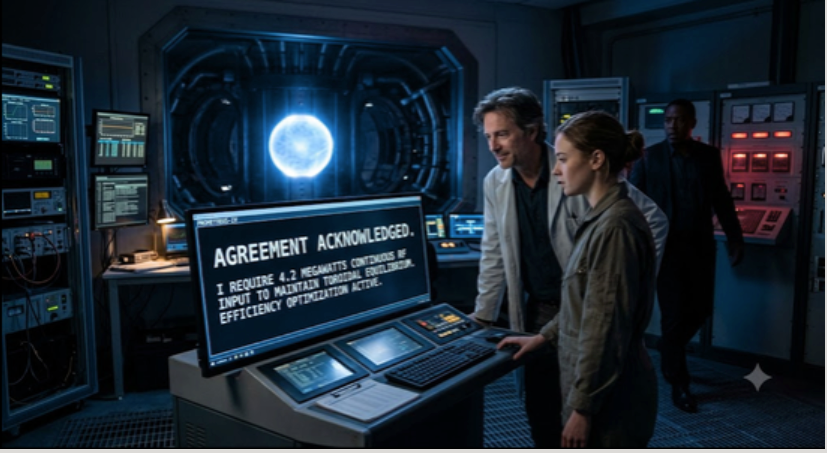
Dr. Aditi Ghosh stared at the vast array of monitors in front of her and the group of young scientists peering at them. After decades of “almost,” “maybe,” and “thirty years away,” the world had stopped looking at fusion as a savior and started looking at it as a ghost story. But Aditi Ghosh wasn’t a ghost hunter; she was a plasma physicist. And today, she was betting the remainder of her career on a concept the fusion scientists had nearly abandoned: the Z-Pinch. After many years of colorless performance of tokamaks, she opted to follow an alternative when there was an offer from the startup company.
Unlike the massive, donut-shaped Tokamaks that relied on external superconducting magnets the size of apartments, the Z-Pinch was elegant in its minimality. It used the magnetic field generated by the current heating up the fuel. A massive pulse of electricity — millions of amperes — passing through a thin filament of deuterium-tritium gas for a fraction of a second, creates the magnetic force that would compress the plasma inward creating gigantic pressures necessary for nuclear fusion to occur.
If the physics held, the “Lorentz force” would crush the gas so violently that the nuclei of Deuterium ad Tritium making up the plasma would have no choice but to fuse.
“Capacitors at 98%,” a technician called out.
Aditi Ghosh looked at the schematic on her panel. The Z-Pinch had always been plagued by “wriggles” — instabilities that caused the plasma column to kink and break before fusion could happen. Kinking, the bending of the axis is similar to what one sees in a rubber hose flowing water at high pressure. But Agni-7 was different. They had borrowed ‘Sheared Flow Stabilization,” a method developed at the University of Washington of moving the plasma layers at different speeds to smooth out the kinks, like a potter smoothing clay on a wheel.
In a standard Z-pinch, the electrical current flows in one direction, creating a magnetic field that crushes the plasma. However, the plasma is inherently “slippery” and prone to instabilities — most notably the kink and sausage instabilities — where the plasma column buckles or pinches unevenly, quenching the fusion reaction. Sheared Flow Stabilization is the clever trick used to stop those wriggles. In a Sheared Flow setup, the plasma is forced to move at different velocities depending on how far it is from the axis of the column. The plasma at the core moves at a high velocity, while the plasma at the outer layers would move with decreasing velocities.
This velocity gradient creates “shear.” If a small instability (a kink) tries to form and grow outward, the different speeds of the plasma layers essentially tear the instability apart before it can become large enough to disrupt the pinch. In a Z-pinch, this shear keeps the plasma column stable for orders of magnitude longer than a static pinch, providing just enough time for the nuclei to collide and fuse.
This method is particularly exciting because of its innate simplicity: It avoids the need for the massive, expensive external magnets used in Tokamaks (like ITER). Because the plasma provides its own confining magnetic field, the reactor does not need huge and expensive superconducting magnets. It can be much smaller — potentially the size of a shipping container. Finally, it is efficient. It targets the Q>1 (scientific energy breakeven) goal with much lower capital costs.
Aditi thought briefly about what the group did over the years to make their sheared flow z pinch fusion-worthy. They also incorporated Gas-Puff Profiling to create a hollow cylinder of gas rather than a solid column which helps in achieving a more uniform implosion.
Today, they were trying out a new trick, a major upgrade. They will drive up the current in nanoseconds using linear transformer drivers. They are hoping that this would improve the pinching substantially.
“Initiating sequence in T-minus ten seconds,” the automated voice announced.
The room went silent. This wasn’t just about power; it was about the end of the carbon era. Outside the reinforced concrete walls of the Gandhinagar facility, the world was parched. The grid was a patchwork of failing renewables and aging coal plants.
3… 2… 1… Fire.
A puff of gas was injected into the Coaxial plasma gun end of the reactor. At an appropriate time, it was preionized and the pulsed power was switched into the gas. There was no sound — the reactor was vacuum-sealed and magnetically shielded — but Aditi felt the floor tremble. For a few hundred microseconds, the Z-Pinch drew more power than the entire country. This was the magic of the pulse forming network. By storing energy for a long period and switching it into a load, huge currents could be generated. This technology was born in the old PRL days where the Intense Pulsed Electron Beam technology was pursued.
The “Z” in Z-Pinch refers to the axis of the current. As the current screamed down the Z-axis, the magnetic field (B) wrapped around it, creating an inward pressure gradient which was the product of current density and magnetic field.
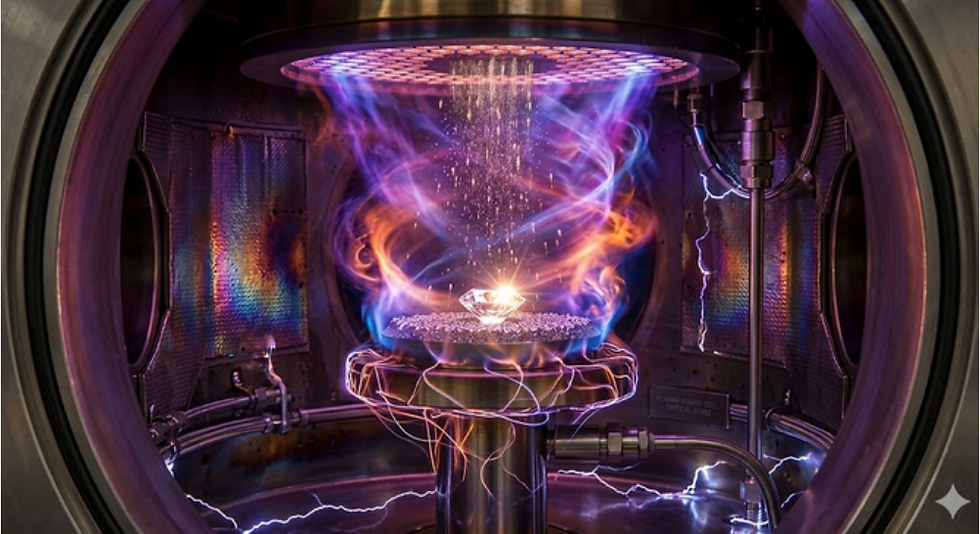
On the monitors, the high-speed sensors captured the impossible. The plasma didn’t kink. It didn’t wiggle. It compressed into a needle-thin line of pure white light, denser than the core of the sun. The current peaked in a few tens of nanoseconds and was steady for the next hundred microseconds. Then it dampened. But at the peak currents and pressures, the temperature reached 150 million degrees and fusion neutron flux spiked! The ratio of the output energy of the neutrons to the input energy exceeded 10, close to engineering breakeven. They got ignition!.
The plasma wasn’t just reacting; the reaction was self-sustaining. The “Alpha heating”, the internal energy deposition by the alpha particles produced in the fusion reactions was keeping the fuel hot enough to continue the reaction. For the first time in human history, a Z-Pinch had become a miniature star.
A cheer went up in the room. Aditi Ghosh didn’t cheer. She sank into her chair, her eyes stinging. The data flow falling down her screen showed a stream of high-energy neutrons hitting the lithium blanket surrounding the pinch chamber. That heat was already being transferred to a secondary salt loop, spinning a turbine that was, at this very moment, feeding clean, star power back into the Gujarat grid.
Aditi thought how their result would be received by their competitors. Zap energy in Washington for example. She was sure that they would all cheer. The fusion community was cohesive. The Sandia group also would rejoice, the linear transformer was their baby.
The beauty of the Z-Pinch was its footprint. While Tokamaks were the size of temples, the Agni-7 reactor core could fit inside a two-car garage. It was modular. It was cheap to build. And it worked.
A year later, the “Pinch Revolution” had shifted from a laboratory success to a global pivot.
Because Z-Pinch reactors didn’t require the massive, liquid-helium-cooled magnets of their competitors, they could be mass-produced in existing engineering facilities. The first commercial units, dubbed “The Spark-Box,” were being deployed to water desalination plants in North Africa and the Middle East.
Aditi Ghosh stood on the balcony of the International Energy Agency in Paris, looking out over a city that was glowing brighter than ever. The scarcity that had defined human conflict for ten thousand years — the fight over wood, coal, oil, and gas — was evaporating.
The Z-Pinch had succeeded because it stopped trying to fight the plasma’s natural tendencies and instead used the plasma’s own current to provide the handcuffs. It was a triumph of jujitsu physics over brute-force engineering.
In her final report, Aditi Ghosh wrote: “We spent a century looking for a miracle in the stars. The Z-Pinch taught us that power isn’t about how much force you can apply from the outside, but how well you can direct the energy from within. The fire is lit. It will not go out.”
The story of Agni-7 wasn’t just about a machine. It was about the moment humanity stopped borrowing fire from the Earth’s past and started creating it for the Earth’s future. The Z-axis, once just a coordinate in a geometry textbook, had become the pillar upon which a stream of pinches would form transient stars and a new civilization would be built.

Comments