
Black Gold, Cold Plasma.


The humid breeze of the Arabian Sea carried the heavy, unmistakable scent of
cardamom and black pepper across the Willingdon Island docks. For Madhav
Menon, that fragrance was as much heritage; as it was a challenge.
As a third-generation spice exporter in Cochin, Menon was steeped in spice stories.
The “Queen of the Arabian Sea” had traded in “Black Gold” for centuries. But the
modern global market was not much impressed by history; It was obsessed with
safety. A single shipment rejected by the EU for aflatoxin contamination could
bankrupt a small firm and tarnish a reputation built over decades.
Menon looked at his warehouse. Steam sterilization — the industry standard — was
effective at killing microbes, but it was brutal. The vibrant green of the Alleppy
Green Cardamom was lost in the process. Steam also blew away the volatile oils that
gave Malabar pepper its bite.
“We are killing the soul of the spice to save its safety,” Menon told his lead engineer,
Anjali. “We need a way to decontaminate without the heat.”
Menon decided to investigate. His friends from Cochin University had told him of
the cold plasma sterilization work being done at the Institute for Plasma Research in
Gandhinagar in distant Gujarat. He and Anjali visited the institute and had detailed
discussions. The consequence was that he decided to invest in a state-of-the-art,
Cold Plasma processing facility, the first of its kind in Kerala’s spice hub. Unlike
steam processing, cold plasma works at room temperature by ionizing ambient air
to create a reactive field of ions, electrons, and free radicals.
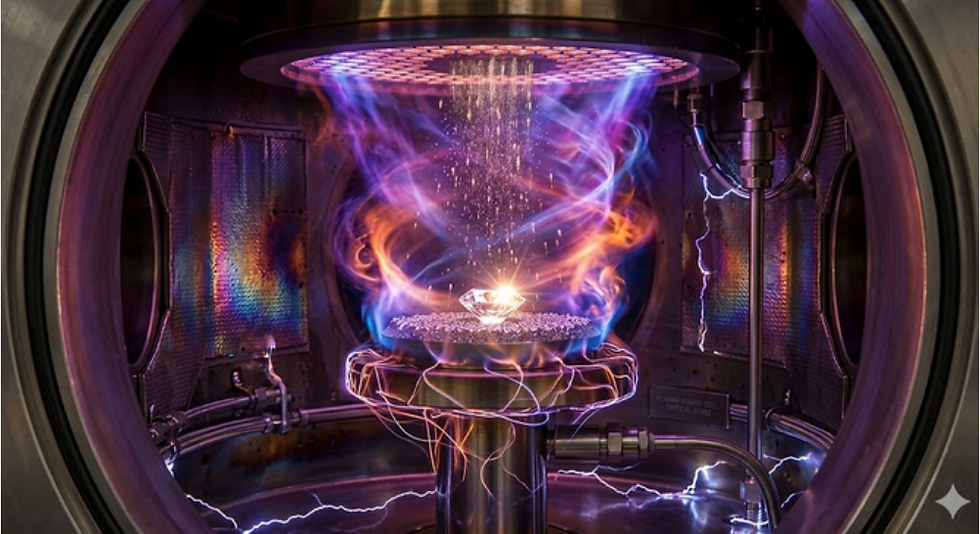
Anjali oversaw the installation of the dielectric barrier discharge (DBD) reactor. “It’s
elegant, Madhav,” she explained, pointing to the glowing violet hue emanating from
the treatment section. “The reactive oxygen and nitrogen species (RONS) attack the
cell membranes of bacteria and physically degrade the molecular structure of
aflatoxins. But because it’s ‘cold,’ the piperine in our pepper and the cineole in our
cardamom remain totally unaffected.”
To understand how Menon’s facility works, you have to imagine it as a high-tech
“laundry” for germs and toxins. Instead of using soap and water, it washes with
ionized air.
The heart of the facility is a glass-shielded chamber. As the spices move through on
a specialized mesh belt, they pass through large zone of soft, violet glow created by
an array of dielectric barrier discharge applicators initiated by a high voltage
microsecond pulse train. This strips electrons away from the oxygen and nitrogen
molecules, turning the air into a ‘soup’ of highly reactive particles.”
2 of 8 27/06/26, 6:26 pmBlack Gold, Cold Plasma. The humid breeze of the Arabian Sea… | by ... https://medium.com/@john-pucadyil/black-gold-cold-plasma-d30c358...
These particles — called Reactive Species — act like microscopic scissors. When they
hit a bacterium or a mold spore, they tear through the outer protective layer,
effectively neutralizing the threat without needing heat.
To understand why Menon’s plasma facility was so revolutionary, one had to look at
the fabled history of Fort Kochi. Long before Irving Langmuir named the glowing
gas plasma, Cochin was the centre of a maritime world involving Europeans and
Arabs.
Menon often reminded his investors that they weren’t just shipping “food
ingredients” — they were purveyors of a currency that once commanded the world.
Two thousand years before the European Union set its strict safety standards, the
Roman Empire was already obsessed with Malabar.
Ancient texts tell of massive Roman ships that rode the monsoon winds from the
Red Sea to the port of Muziris, in Cranganore, north of modern-day Cochin. In
Rome, black pepper was weighed against gold. It was so vital that when Alaric the
Goth besieged Rome in 408 AD, he demanded 3,000 pounds of pepper as part of the
city’s ransom.
This ancient trade didn’t just bring back pepper; it brought back tales of a land
where the sun was fierce and the air was thick with the scent of “the black gold.”
The legacy Menon inherited was forged during the “Spice Wars.” For centuries, the
Silk Road was the only way for spices to reach Europe, passing through dozens of
middlemen until prices were astronomical.
In 1498, when Vasco de Gama, the Portuguese navigator finally rounded the Cape of
Good Hope and landed on the Malabar Coast, the world changed forever. He wasn’t
looking for new lands; he was looking for a direct route to the very cardamom and
ginger Menon was now treating with cold plasma. The Dutch, the Portuguese, and
the British all left their mark on Cochin’s skyline. They built massive stone
warehouses — the “godowns” — to protect their spice hoards from the very same
humidity and mold that Madhav was now fighting with high-frequency electricity.
3 of 8 27/06/26, 6:26 pmBlack Gold, Cold Plasma. The humid breeze of the Arabian Sea… | by ... https://medium.com/@john-pucadyil/black-gold-cold-plasma-d30c358...
The most impressive part of the treatment is its ability to handle Aflatoxins — toxic
chemicals produced by certain molds that are incredibly hard to destroy. Standard
cooking or boiling doesn’t kill aflatoxins; they are heat-stable. However, the
“chemical storm” inside the plasma chamber is different. The reactive ions target
the specific chemical bonds (the furan rings) that make the toxin dangerous. By
breaking those bonds, the plasma turns a poisonous molecule into a harmless
fragment. It’s a chemical transformation that happens in seconds at room
temperature.
The “Cold” in Cold Plasma is the secret to Menon’s business success. In traditional
steam treatment, the temperature reaches 100°C to 120°C, which causes two
problems: The delicate oils (like piperine in pepper) evaporate, taking the flavor
with them or the High heat “cooks” the spice, turning bright greens into dull
browns.
In Menon’s DBD reactors, the gas molecules remain at room temperature. Only the
tiny electrons are “hot” and energetic. This means the spice pod stays cool and
intact, keeping its weight, its punchy aroma, and its market value. At the back of the
facility, a wall of monitors tracks the metabolomic fingerprint of the spices. Sensors
measure exactly how much ozone and nitrogen oxide are produced.
“Every spice is different,” Anjali notes. “Black pepper has a hard shell, so it can
handle a higher ‘dose’ of plasma. Ground turmeric is a fine powder with more
surface area, so we have to use a gentler, more turbulent airflow to ensure every
grain gets treated without over-processing.” This precision ensures that when a
container leaves Cochin for New York or London, it isn’t just safe — it’s scientifically
perfect.
The facility’s first major test came when a batch of nutmeg from the rural highlands
tested slightly above the permissible limit for Aflatoxin B1. Normally, this would be
a total loss.
Menon and Anjali ran the batch through the plasma conveyor. They meticulously
calibrated the Gas Composition: Using a mix of Argon and Air. The Voltage was set :
4 of 8 27/06/26, 6:26 pmBlack Gold, Cold Plasma. The humid breeze of the Arabian Sea… | by ... https://medium.com/@john-pucadyil/black-gold-cold-plasma-d30c358...
High enough to bridge the gap, but optimized to prevent “arcing.” Exposure Time:
Just long enough to break the furan ring of the aflatoxin molecule.
A week later, the lab results came back. The microbial load was negligible, and the
aflatoxins had been reduced by 85%, bringing them well within international safety
limits.
But the real test was sensory. Menon invited a veteran spice cupper to sample the
plasma-treated cardamom. The old man inhaled deeply, then cracked a pod. “It still
has the ‘pop,’” he remarked. “The color is vibrant, and the aroma… it’s like it was
picked yesterday.”
Menon’s facility quickly became the talk of the Cochin Chamber of Commerce.
However, he knew the journey wasn’t over. While the plasma worked wonders on
flat surfaces like dried chili, the complex crevices of a nutmeg seed required more
“dwell time.”
He began collaborating with the local university to integrate metabolomic mapping,
ensuring that the plasma wasn’t creating any unknown by-products. He wasn’t just
building a factory; he was creating a blueprint for the future of Indian food safety.
Menon walked through his facility, where the violet light of the plasma reactors
hummed in the same air where Portuguese sailors once hauled heavy sacks of
pepper onto wooden galleons.
“The Greeks called it peperi, the Romans called it piper, and today, the world calls it
a ‘high-risk commodity’ if it isn’t clean,” Madhav mused.
For two thousand years, the challenge had been the distance — how to get the spice
from Cochin to Europe through storms and pirates. Today, the challenge was biology
— how to get it there free of the invisible toxins and microbes that the ancient
traders never knew existed.
By using cold plasma, Menon wasn’t just being an entrepreneur; he was the latest
guardian of a bridge between the East and West that had survived the fall of Rome,
the Renaissance, and the Industrial Revolution. He was ensuring that the “Queen of
the Arabian Sea” would remain the world’s pantry for the next thousand years.
As he looked out over the backwaters, Madhav Menon realized that the ancient spice
trade didn’t need to fear the future. It just needed a little bit of lightning, captured in
a bottle.


Comments